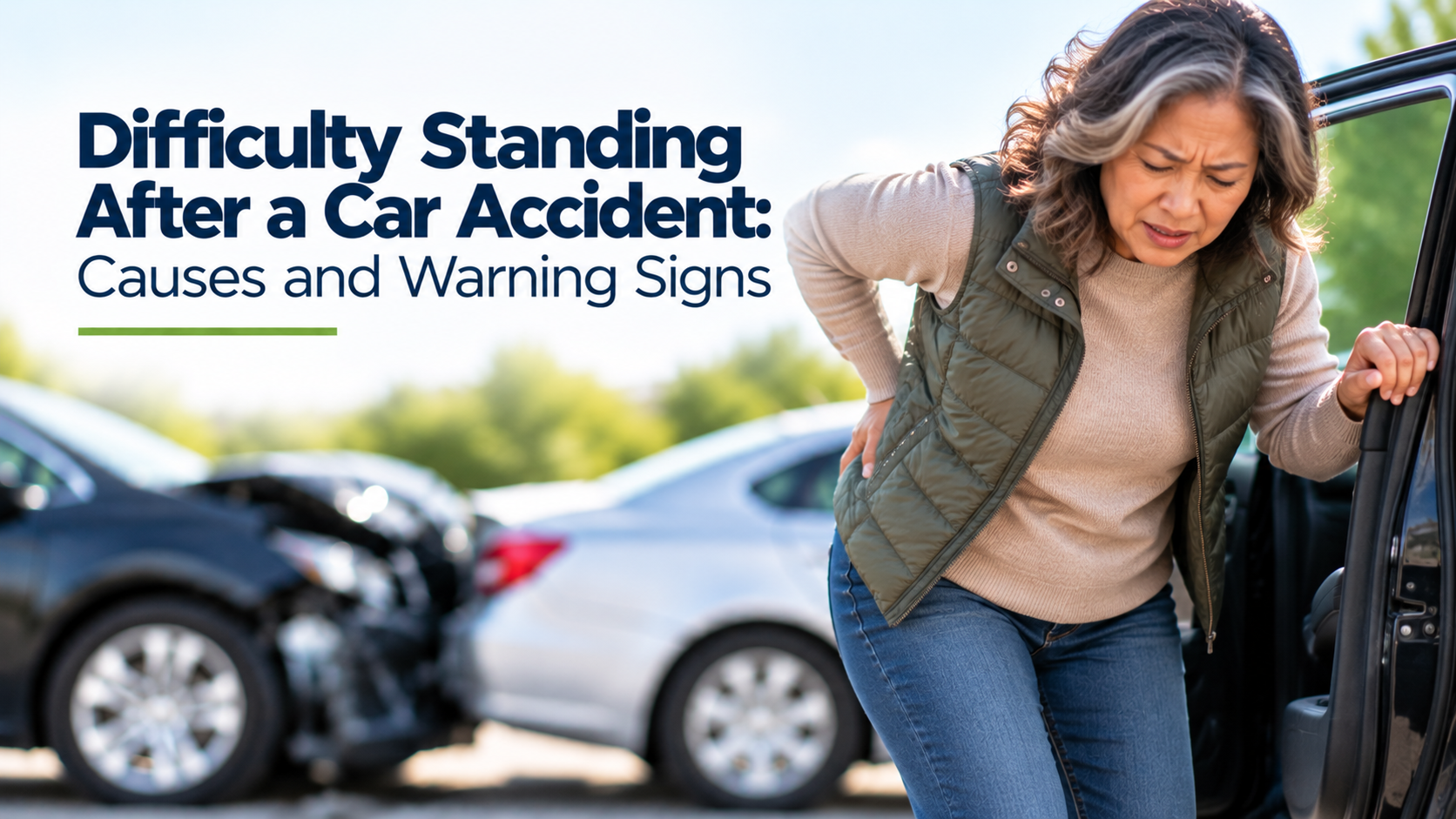
Difficulty Standing After a Car Accident: Causes and Warning Signs
Difficulty standing after a car accident can result from pain, weakness, dizziness, joint injury, lower-back or pelvic injury, or neurological problems. Inability to stand or bear weight, rapidly worsening weakness, severe dizziness, major numbness, deformity, or loss of bladder or bowel control requires prompt medical evaluation.
Difficulty Standing After a Car Accident: Common Causes
Standing requires the legs, hips, pelvis, spine, balance system, and nervous system to work together. Related functional problems may include difficulty bending after a car accident or difficulty climbing stairs after a car accident.
- Possible contributors include:
- Hip, knee, ankle, or foot injury
- pelvic pain after a car accident or back pain after a car accident
- Muscle strain or guarding
- leg weakness after a car accident
- Nerve irritation or injury
- dizziness after a car accident
- Head or spinal injury
Difficulty standing after a car accident may involve more than one factor after a collision.
When Is Difficulty Standing an Emergency?
Seek emergency medical care for inability to stand after significant trauma, rapidly worsening weakness, new major numbness and tingling, loss of bladder or bowel control, saddle-area numbness, severe balance loss, a visibly deformed limb, or a cold or discolored foot.
Severe dizziness with neurological symptoms, fainting, chest pain, or other major symptoms also requires urgent assessment.
Is It Pain or True Weakness?
Pain can make a person reluctant or unable to put normal force through an injured leg even when muscle and nerve function are intact. True weakness means expected force cannot be produced despite appropriate effort.
When difficulty standing after a car accident continues, an examination can help distinguish pain-limited movement from neurological weakness.
Could Dizziness Make Standing Difficult?
Yes. Dizziness or balance disturbance can make standing unsafe even when the legs themselves are not injured. Post-accident dizziness can have several causes, including concussion and inner-ear or other balance problems, and should be evaluated appropriately.
How Is Standing Difficulty Evaluated?
A clinician may assess blood pressure and general medical symptoms when relevant, along with balance, strength, sensation, reflexes, joint motion, swelling, walking, and ability to bear weight. The spine, pelvis, hips, knees, ankles, and feet may be examined depending on the presentation.
Imaging or specialist assessment may be needed when fracture, significant neurological injury, or another structural problem is suspected.
Should You Force Yourself to Stand?
Do not force standing or weight-bearing through severe pain, major instability, or neurological symptoms. Use assistance when needed and follow medical guidance about weight-bearing and mobility. If standing problems affect everyday movement, getting up from the floor after a car accident may also need to be assessed.
Recovery and Rehabilitation
Once urgent problems have been excluded, rehabilitation for difficulty standing after a car accident may gradually restore joint motion, leg and trunk strength, balance, standing tolerance, and walking after a car accident. Progress should match the diagnosed injury and functional response. A gradual return to activity after injury should be based on function rather than a fixed timeline.
How T98 Rehab Can Help
T98 Rehab can provide a non-emergency car accident injury evaluation for musculoskeletal causes of difficulty standing after an auto accident and develop a progressive rehabilitation care plan when conservative care is appropriate. Major neurological symptoms, suspected fractures, severe dizziness, or circulation problems require appropriate medical evaluation first.
Frequently Asked Questions
Why can I sit comfortably but have pain when I stand?
Standing increases weight-bearing through the hips, pelvis, spine, knees, ankles, and feet, which can reveal an injury that is less noticeable while seated.
Can back pain make it hard to stand upright?
Yes. Lower-back pain and muscle guarding can limit standing, and nerve-related problems can also affect the legs.
Why do I feel unsteady when I first stand up?
Pain, weakness, dizziness, medication effects, or balance problems may contribute. Significant or persistent unsteadiness should be evaluated.
Should I use a cane or walker?
An assistive device may be useful for some injuries, but it should be selected and fitted appropriately based on your needs.
When should I contact T98 Rehab?
After urgent conditions have been excluded, contact T98 Rehab if pain, weakness, stiffness, or balance limitations continue. Tracking recovery milestones and medical documentation after an injury can help document functional changes that interfere with standing and normal activity.
Related T98 Rehab Resources
- difficulty walking after a car accident
- difficulty bending after a car accident
- difficulty climbing stairs after a car accident
- back pain after a car accident
- dizziness after a car accident
- weakness after a car accident
- rehabilitation care plan
- injury recovery
- car accident chiropractor
Sources
MedlinePlus — Balance Problems
American Academy of Orthopaedic Surgeons (OrthoInfo) — Orthopaedic Conditions
Medical Disclaimer
This article is for general educational purposes and does not provide an individual diagnosis or replace emergency or individualized medical care. Call 911 for an emergency. Individual care decisions require an appropriate examination.