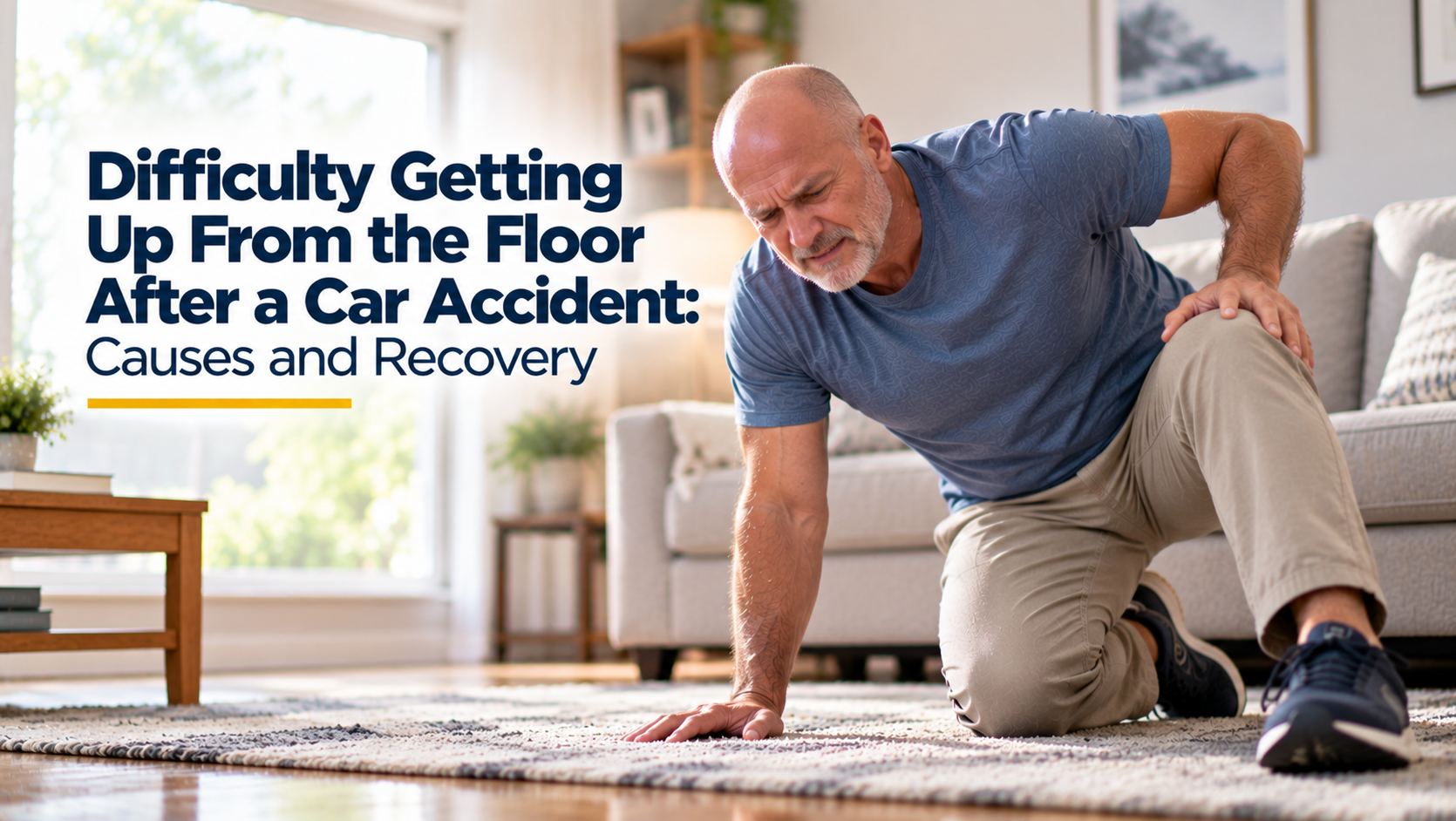
Difficulty Getting Up From the Floor After a Car Accident: Causes and Recovery
Difficulty getting up from the floor after a car accident can reflect pain, weakness, stiffness, or balance problems involving the back, pelvis, hips, knees, ankles, or other injured areas. Rising from the floor requires much more mobility and strength than standing from a normal chair, so it can reveal limitations that are not obvious during basic walking. Inability to bear weight, rapidly worsening weakness, major numbness, severe dizziness, or other neurological warning signs requires prompt medical evaluation.
Why Can Getting Up From the Floor Be Difficult After a Crash?
A floor-to-standing transfer combines several movements. Rising from the floor commonly requires the body to move through a series of low positions while weight shifts between the hands, knees, feet, and legs. The hips and knees may need substantial bending, the ankles and feet must tolerate weight as the body moves upward, and the trunk helps control balance and momentum.
Possible contributors include:
- Lower back pain or pelvic pain
- Hip stiffness or weakness
- Knee pain when kneeling or pushing upward
- Ankle or foot pain during weight-bearing
- Reduced leg strength
- Poor balance or dizziness
- Muscle guarding after injury
- Pain in the shoulder, wrist, or hand when using the arms for support
More than one injured area may contribute to the same functional problem. More than one region can influence the same transfer because the movement is performed as a sequence rather than by one joint alone. For example, hip stiffness may change the kneeling position, knee pain may limit pushing upward, ankle or foot pain may affect final weight bearing, and back pain may alter trunk movement.
Similar problems can appear during squatting or getting on and off the toilet. Tell your clinician which movements cause pain or require help, even if walking seems normal.
When Is Difficulty Rising a Warning Sign?
Seek urgent medical assessment if you cannot bear weight, have a badly swollen or unstable joint, develop significant numbness or cannot safely stand after a collision or fall. Seek emergency care for rapidly worsening leg weakness, new bladder or bowel changes, or numbness around the groin or buttocks. Call 911 for severe symptoms or if you cannot reach emergency care safely.
If you are on the floor after a new fall and may be injured, do not force yourself upright or ask someone to pull you up. Get help and seek assessment. New severe dizziness, fainting or trouble coordinating movement also needs prompt medical attention.
Do not repeatedly practice floor transfers when a fracture or significant neurological injury has not been excluded. Floor-transfer practice can place substantial demand on injured joints and requires enough balance and strength to recover from a low position. Repeated attempts may be unsafe when a fracture, significant neurological injury, or severe balance problem has not been excluded.
How Is a Floor-to-Standing Problem Evaluated?
A clinician may assess hip, knee, ankle, and spinal motion along with leg strength, balance, sensation, walking, and the movement strategy used to rise. Arm and shoulder function may also matter if you depend on your hands for support. The assessment can relate these findings to the specific transfer strategy that has become difficult.
At your first chiropractic visit, bring relevant medical records and describe how your movement has changed. Useful questions to ask your chiropractor include whether you need another medical assessment, what support is appropriate and when you should stop an exercise.
Why Is Getting Up From the Floor Harder Than Standing From a Chair?
A chair begins at a higher position and usually requires less hip and knee motion. Rising from the floor demands greater joint range, leg strength, balance, and coordination. From the floor, the person often has to reorganize the body through several positions before reaching standing.
Other daily challenges, such as getting into a bathtub, may involve the same limits in balance, bending and leg strength. Discuss these tasks so the plan reflects what you actually need to do at home.
Should You Practice This Movement During Recovery?
When medically appropriate, floor transfers can be practiced progressively. Early rehabilitation may use a stable support or higher surface before advancing toward lower positions. A higher starting surface reduces the distance the body must travel and can decrease the amount of hip and knee motion needed.
Do not force deep kneeling, squatting, or pushing through sharp or worsening pain. Sharp or worsening pain during deep kneeling, squatting, or pushing upward can indicate that the current movement demand is too high or that further evaluation is needed. A partial or supported transfer may reduce joint range and strength demands, but progression should remain consistent with the person’s symptoms, examination findings, and medical guidance.
Ask a clinician to assess and teach an appropriate movement strategy before practicing alone. Follow guidance on home exercises and use only support that has been checked for stability. Furniture that rolls, slides or tips is unsafe to pull on.
Getting Up From the Floor: Recovery and Rehab
Rehabilitation may address hip and knee mobility, leg and trunk strength, balance, and safe transfer strategies. Progress can move from higher surfaces toward the floor as function improves. Functional progress can be considered in relation to the height of the starting surface and the amount of support required.
A treatment plan should set goals for everyday movement and the help you need. Injury rehab can address the limits found on examination. Track recovery progress through smoother movement, better balance and less assistance rather than repeated unsupported tests.
Review returning to activity before resuming floor-level work, gardening or exercise. Increase the challenge with clinical guidance rather than changing support, surface height and repetitions all at once.
How T98 Rehab Can Help
T98 Rehab can evaluate musculoskeletal limitations that make floor transfers difficult after an auto accident and develop a progressive rehabilitation plan. Significant neurological symptoms, suspected fractures, or severe balance problems require appropriate medical evaluation first. The evaluation can focus on the same functions required for a floor-to-standing transfer, including hip, knee, ankle, and spinal mobility, leg and trunk strength, balance, sensation, gait, and the use of the arms for support.
When appropriate, chiropractic care may be part of a broader rehabilitation plan. Discuss chiropractic safety, alternatives and whether another clinician should evaluate dizziness or neurological symptoms. After urgent concerns have been addressed, book an appointment for ongoing pain, stiffness or difficulty rising.
Frequently Asked Questions
Why can I walk normally but struggle to get off the floor?
Floor transfers require greater joint motion, strength, and balance than level walking. Level walking usually keeps the body upright and uses a smaller range of hip, knee, and ankle motion. A floor transfer begins from a much lower position and may require kneeling, half-kneeling, squatting, weight shifting, and greater force from the legs and trunk.
Can knee pain make floor transfers difficult?
Yes. Kneeling and pushing upward can place substantial demand on an injured knee. Kneeling places the knee in a deeply bent position and may also place direct pressure through the front of the joint.
Should I pull myself up using furniture?
Stable support may be useful in some rehabilitation situations, but unstable furniture can create a fall risk. A stable support can sometimes reduce balance demand or provide assistance during a carefully selected rehabilitation progression. However, furniture that slides, tips, or is too low can create another fall risk.
Can back or hip pain affect this movement?
Yes. Both regions contribute substantially to bending, shifting weight, and rising. Back and hip function help position the trunk and pelvis as body weight shifts from the floor toward the feet.
When should I contact T98 Rehab?
After urgent injuries have been excluded, contact T98 Rehab if pain, weakness, stiffness, or balance problems continue to limit transfers and daily activity. Continued difficulty with floor transfers is useful to report because the task combines joint mobility, leg and trunk strength, balance, coordination, and sometimes arm support. Describing which part of the transfer causes pain or instability and whether a stable support is needed can help focus the evaluation on the functions that remain limited.
Sources
Medical Disclaimer
This article provides general education and does not diagnose an injury or replace an individual examination, treatment plan or emergency care. Difficulty rising can have several causes. Get appropriate medical assessment before practicing painful or unsafe movements. Call 911 for an emergency.