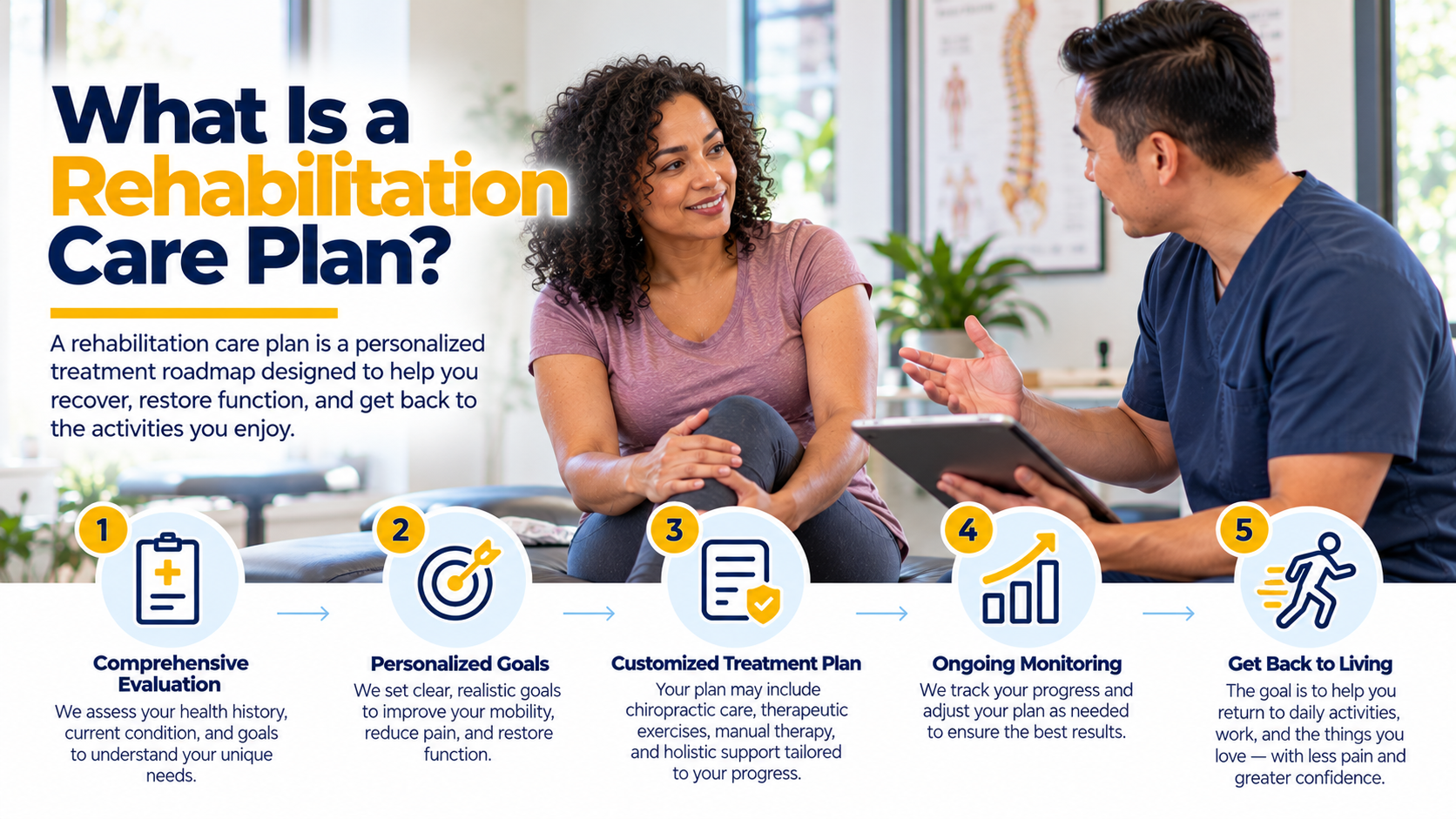
What Is a Rehabilitation Care Plan?
Rehabilitation Care Plan: Goals, Treatment and Reassessment
A Care Plan Is a Roadmap, Not a Guarantee
A rehabilitation care plan is an individualized roadmap for helping a person regain, maintain or improve abilities affected by an injury or health condition. It connects the evaluation findings with meaningful goals, selected treatments, home activities, safety instructions and scheduled reassessment.
A rehabilitation care plan is not a promise that recovery will follow a fixed timeline. It should change when the patient’s condition, response, goals or clinical needs change.
Why Rehabilitation Focuses on Function
Pain matters, but rehabilitation usually looks beyond a pain score. The larger purpose is to improve the abilities a person needs for daily life, independence, work, driving, exercise and other meaningful activities.
After a car, truck, motorcycle or boating injury, examples may include difficulty turning your head while driving, sitting through a work shift, lifting a child, sleeping more comfortably, walking longer distances or returning gradually to recreation.
The Main Parts of a Rehabilitation Care Plan
1. Clinical History and Baseline Evaluation
The plan begins with an accurate history and examination. The provider may document:
- How and when the injury occurred.
- When symptoms began and how they have changed.
- Pain location, quality and aggravating or relieving factors.
- Previous injuries, surgeries and relevant health conditions.
- Medications, allergies and safety considerations.
- Movement, strength, sensation, coordination or other appropriate examination findings.
- Effects on sleep, work, driving and daily activities.
- Warning signs that require urgent evaluation or referral.
In a rehabilitation care plan, the baseline enables later comparison. It also helps determine whether the clinic is an appropriate setting or whether another healthcare professional should be involved.
2. Working Clinical Impression
The provider should explain the current clinical impression in understandable language, including what is reasonably supported, what remains uncertain and which serious conditions have been considered.
A working impression may change as symptoms evolve, test results become available or the patient responds differently than expected.
3. Patient-Centered Goals
Good goals are meaningful to the patient and measurable enough to guide decisions. They may address:
- Reducing a specific functional limitation.
- Improving range of motion or controlled strength.
- Tolerating sitting, standing or walking for longer periods.
- Sleeping with fewer disruptions.
- Returning to modified and then regular work duties.
- driving after a car accident safely after appropriate clinical clearance.
- Resuming exercise, recreation or caregiving tasks.
Goals should be realistic, prioritized and reviewed with the patient. A goal such as “feel better” can be clarified into observable abilities that both patient and provider can track.
4. Selected Interventions
The plan identifies which interventions are being considered and why. Depending on the patient and provider’s scope, these may include education, activity modification, therapeutic exercise, mobility work, manual therapies, symptom-management strategies or coordination with another clinician.
The provider should discuss the expected purpose, potential benefits, material risks and reasonable alternatives. No treatment is right for every injury.
5. Home Activities and Self-Management
Rehabilitation continues between visits. A home plan may include:
- Specific exercises with clear instructions.
- Activity pacing and gradual progression.
- Temporary modifications for work or household tasks.
- Position changes and movement breaks.
- Sleep or ergonomic strategies.
- home exercise safety signs that mean an exercise should stop.
- Instructions for contacting the clinic if the condition changes.
Patients should understand how often to perform each activity, what response is expected and which symptoms require reassessment.
6. Visit Frequency and Expected Review Points
A care plan may recommend an initial visit frequency, but that frequency should be connected to the patient’s needs and response. It should not be treated as an unchangeable package.
A rehabilitation care plan should identify when formal reassessment will occur. Improvement may support progression or reduced visit frequency; limited progress may lead to a revised diagnosis, different treatment, referral or another opinion.
7. Safety and Escalation Instructions
Every plan should distinguish routine symptom fluctuations from warning signs that need urgent attention. Call 911 or seek emergency care for severe or worsening symptoms, loss of consciousness, repeated vomiting, chest pain, breathing difficulty, new weakness, loss of coordination, uncontrolled bleeding or any potentially life-threatening condition.
Possible concussion, fracture, spinal cord involvement and other serious conditions require medical evaluation beyond routine non-emergency rehabilitation.
How Progress Is Measured
Progress measurement should combine patient reports with appropriate objective or functional findings. Examples include:
- Pain pattern and symptom frequency.
- Range of motion.
- Strength or movement control.
- Walking, sitting or standing tolerance.
- Sleep quality.
- Ability to drive, work or complete daily tasks.
- Use of medication or other symptom-management strategies.
- Completion and response to home activities.
- Progress toward the patient’s stated goals and recovery milestones.
Not every measure improves at the same rate. A patient may still report some pain while demonstrating better movement and function, or may need reassessment when pain improves but weakness or neurological symptoms remain.
When a Care Plan Should Change
A rehabilitation plan should be reviewed when:
- Symptoms become significantly worse or new warning signs appear.
- Progress is faster or slower than expected.
- The patient reaches a goal and is ready for returning to activity after an injury.
- Treatment causes an unexpected or unacceptable response.
- A new diagnosis or test result changes the clinical picture.
- Work, transportation, finances or caregiving affect participation.
- The patient’s goals or preferences change.
- Care from another provider needs to be coordinated.
Changing a plan is not automatically a failure. It is part of responsive, patient-centered care.
Who May Participate in Rehabilitation
Rehabilitation needs differ. One person may receive care from a single clinician, while another may need coordinated services involving primary care, physical medicine and rehabilitation, orthopedics, neurology, physical therapy, occupational therapy, behavioral health or other professionals.
The appropriate team depends on the injury, symptoms, goals and scope of each provider. Ask who is responsible for each part of care and how records will be shared with authorization.
Rehabilitation After an Auto or Boating Injury
After a car, truck, motorcycle or boating accident, a care plan should be based on clinical needs rather than the existence of an insurance or legal claim. medical records may document the history, findings, functional limits, recommendations, attendance, response and referrals.
T98 Rehab may help organize authorized clinical records and communicate with insurers or legal representatives when permitted. It may connect patients with legal resources upon request, but it does not provide legal advice, determine fault, value claims or guarantee compensation.
Questions to Ask About Your Care Plan
- What findings does this plan address?
- What are the short-term and longer-term goals?
- How will progress be measured?
- Why is each treatment or exercise recommended?
- What are the potential benefits, risks and alternatives?
- How often will the plan be reassessed?
- What should I do if symptoms worsen?
- When would imaging, referral or another opinion be appropriate?
- What can I safely do at home, work and during exercise?
- How will other providers be kept informed?
Frequently Asked Questions
Is a rehabilitation care plan the same for everyone?
No. The plan should reflect the individual’s evaluation, health history, functional limitations, goals, preferences and response.
How long does a rehabilitation care plan last?
There is no universal duration. The provider should use reassessment and measurable progress rather than guarantee a fixed recovery date.
Does a care plan always include chiropractic adjustment?
No. The selected interventions depend on the patient’s condition, safety considerations, preferences and the provider’s clinical judgment. Referral or co-management may be more appropriate in some cases.
What if I am not improving?
Tell the provider. The plan may need to be modified, the working impression reconsidered, or another healthcare professional consulted.
Can a care plan help document an accident injury?
It can create an accurate clinical record of findings, goals, services and response. It does not prove legal fault or guarantee insurance payment or a legal outcome.
Rehabilitation Care at T98 Rehab
T98 Rehab & Chiropractic provides car accident treatment and individualized chiropractic care for appropriate non-emergency musculoskeletal injuries after car, truck, motorcycle and boating accidents. To schedule, call 512-614-2330.
- North Austin — 1139 Braker Lane #101, Austin, TX
- South Austin — 2512 S. I-35 Frontage Road #260, Austin, TX
- Pflugerville — 201 N. Heatherwilde Boulevard #104, Pflugerville, TX
Related T98 Rehab Resources
- injury recovery
- return to activity after injury
- home exercise safety
- medical documentation after an injury
- chiropractic visits
- schedule a chiropractic appointment
Sources
Medical and Legal Disclaimer
This article is for general educational purposes and does not replace individualized medical evaluation or legal advice. Rehabilitation recommendations depend on the patient’s history, examination and circumstances. Seek emergency care for urgent symptoms. T98 Rehab does not guarantee recovery, insurance coverage or legal outcomes.