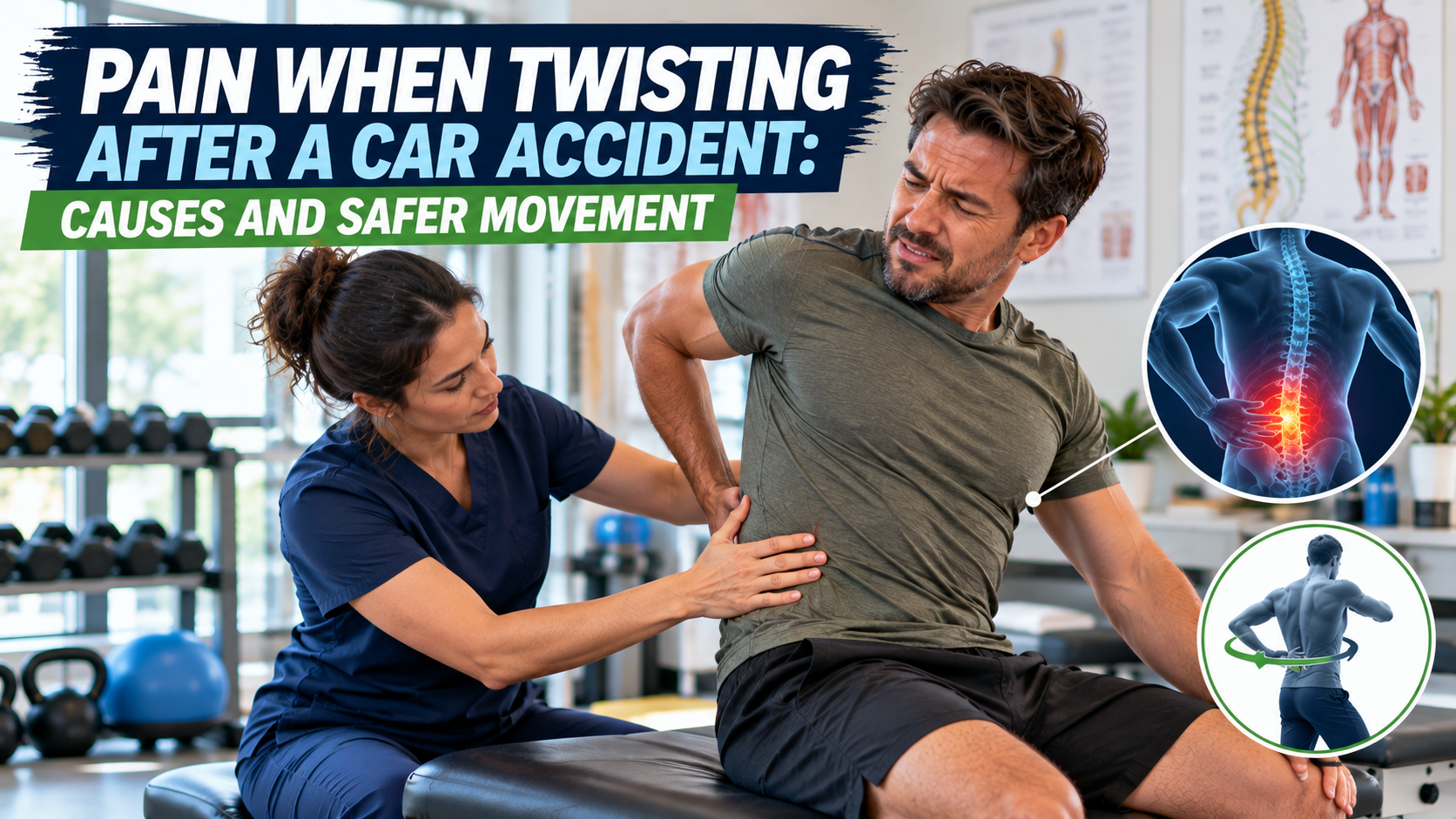
Pain When Twisting After a Car Accident: Causes and Safer Movement
Pain when twisting after a car accident can come from the back, ribs, abdominal wall, hips, pelvis, or surrounding muscles and joints. Rotation is part of getting out of bed, entering a vehicle, reaching behind you, and many work or household tasks. Severe chest or abdominal pain, breathing difficulty, major neurological symptoms, or rapidly worsening pain after trauma requires prompt medical evaluation.
Why Can Twisting Hurt After a Crash?
Rotation distributes movement through several regions rather than one joint. During a normal turn, movement is distributed through the thoracic and lumbar spine, hips, pelvis, ribs, abdominal wall, and surrounding muscles. The feet may also reposition when the whole body turns.
Possible contributors include:
- Back muscle or ligament strain
- Upper-back joint irritation or lower back pain
- Rib or chest-wall injury
- Abdominal muscle strain
- Hip or pelvic pain
- Muscle guarding or spasm
- Pain from multiple injured regions
The location of pain and whether it is sharp, aching, radiating, or associated with other symptoms can help guide evaluation. The pattern of pain can provide useful context. Local aching may behave differently from sharp pain with a particular direction of rotation, while radiating pain, numbness, or weakness may suggest that neurological assessment is important.
When Is Pain With Twisting a Warning Sign?
Seek emergency care for severe or worsening chest or abdominal pain, breathing difficulty, fainting, coughing up blood or severe pain after a serious collision. New bladder or bowel changes, numbness around the groin or rapidly worsening weakness also require emergency assessment. Call 911 for severe symptoms or if you cannot reach emergency care safely; do not drive yourself.
Pain with breathing, coughing, or abdominal tenderness after a collision should not automatically be treated as a routine muscle strain. Chest or abdominal symptoms after trauma deserve particular attention because pain in these regions is not always caused by a simple muscle strain. Pain that is severe, rapidly worsening, associated with breathing difficulty or fainting, or accompanied by marked tenderness should be evaluated promptly.
Our guide to pain when breathing explains why chest symptoms deserve attention. Do not delay urgent care to try stretches or arrange a routine rehabilitation visit.
How Is Twisting Pain Evaluated?
A clinician may assess spinal, rib, hip, and trunk movement along with strength, sensation, reflexes, tenderness, breathing-related symptoms, and the exact motions that reproduce pain. The assessment can relate symptoms to the specific direction and type of movement that causes pain. Spinal, rib, hip, and trunk motion may be compared with tenderness and strength findings, while sensation and reflexes help identify neurological changes.
Imaging or additional medical evaluation may be needed when fracture, internal injury, or significant neurological involvement is suspected. The need for imaging or additional medical assessment depends on the history, trauma mechanism, examination findings, and associated symptoms rather than the presence of twisting pain alone. Concern for fracture, internal injury, neurological involvement, or significant chest or abdominal injury changes the priority from routine mobility work to appropriate medical evaluation.
For your first chiropractic visit, note the pain location, which direction hurts and whether breathing or coughing changes the symptoms. Bring relevant medical records. Useful questions to ask your chiropractor include whether another medical evaluation is needed before treatment.
Should You Stretch or Twist Through the Pain?
Avoid forceful twisting through sharp, severe, radiating, or worsening pain. Once serious injury has been excluded, controlled mobility may be introduced according to the affected tissues and stage of recovery. Controlled mobility means using a range and speed that are appropriate for the injury rather than trying to stretch through pain to restore motion quickly.
Ask which home exercises are appropriate and how to adjust or stop them if symptoms change. Avoid treating painful rotation as a flexibility challenge or repeatedly testing how far you can turn. A clinician can distinguish suitable movement practice from an activity that needs to wait.
Why Does Twisting Matter for Daily Function?
Rotation is used when checking behind you, rolling in bed, getting into a vehicle, reaching across the body, dressing, and lifting. Restricted rotation can therefore affect many activities even when straight-ahead walking is comfortable. This is why twisting pain can interfere with daily function even when walking in a straight line feels relatively comfortable.
For example, vacuuming combines turning, reaching and pushing, while carrying a child adds weight that can shift unexpectedly. Explain which tasks have become difficult so your plan reflects everyday demands. Review safe lifting before returning to heavy or awkward loads.
Recovery and Rehab for Pain When Twisting
Rehabilitation may gradually restore comfortable trunk and hip motion, strength, coordination, and tolerance for rotational tasks. Progression should emphasize controlled movement rather than forcing range. Functional progress can be considered in relation to comfortable range, movement control, and tolerance for practical rotational tasks.
A treatment plan should connect movement goals to the activities you need to regain. Injury rehab can address the limits identified during examination. Track recovery progress through easier daily movement and better control rather than greater rotation at any cost.
Discuss returning to activity before resuming work or exercise that involves repeated turning. Progress range, resistance and repetitions with guidance rather than increasing every demand at once.
How T98 Rehab Can Help
T98 Rehab can evaluate musculoskeletal causes of painful twisting after an auto accident and develop a progressive rehabilitation plan. Significant chest, abdominal, neurological, or structural warning signs require appropriate medical evaluation first. The evaluation can relate painful rotation to the daily activities that have become difficult, such as rolling in bed, entering a vehicle, dressing, reaching, or lifting.
When appropriate, chiropractic care may be part of a broader rehabilitation plan. Discuss chiropractic safety, benefits, risks and alternatives before treatment. After urgent concerns are addressed, book an appointment if painful twisting continues to limit daily life.
Frequently Asked Questions
Why does twisting hurt more than bending forward?
Rotation stresses tissues differently from forward bending, so some injuries are more noticeable during twisting. Forward bending and rotation distribute movement and load differently through the spine, ribs, abdominal wall, hips, pelvis, and surrounding muscles. An injured or guarded region may tolerate movement in one direction better than another.
Can rib injuries hurt when I rotate?
Yes. Rib and chest-wall injuries can be painful with trunk rotation, deep breathing, or coughing and should be evaluated when symptoms are significant. Rib and chest-wall structures move with trunk rotation and also respond to breathing and coughing.
Can hip or pelvic pain affect twisting?
Yes. Rotation involves the hips and pelvis as well as the spine. The hips and pelvis contribute to turning the body, changing direction, getting into a vehicle, and reaching across or behind the body.
Should I avoid all rotation until pain disappears?
Not necessarily. The appropriate amount of movement depends on the injury and medical guidance, but forceful painful twisting should be avoided. Avoiding every rotational movement for an extended period is not automatically necessary once urgent injuries have been excluded.
When should I contact T98 Rehab?
After urgent conditions have been excluded, contact T98 Rehab if pain or restricted rotation continues to interfere with daily activities. Persistent pain with rotation is useful to report because twisting is built into many ordinary movements. Describing the location and quality of pain, the direction that is limited, whether symptoms occur with breathing or coughing, and whether weakness, numbness, or other neurological symptoms are present can help focus the evaluation on the functions and warning signs that matter most.
Sources
Medical Disclaimer
This article provides general education and does not diagnose an injury or replace an individual examination, treatment plan or emergency care. Pain after a car accident can have several causes, including injuries that require urgent medical care. Seek appropriate assessment before resuming painful twisting, stretching or lifting. Call 911 for an emergency.