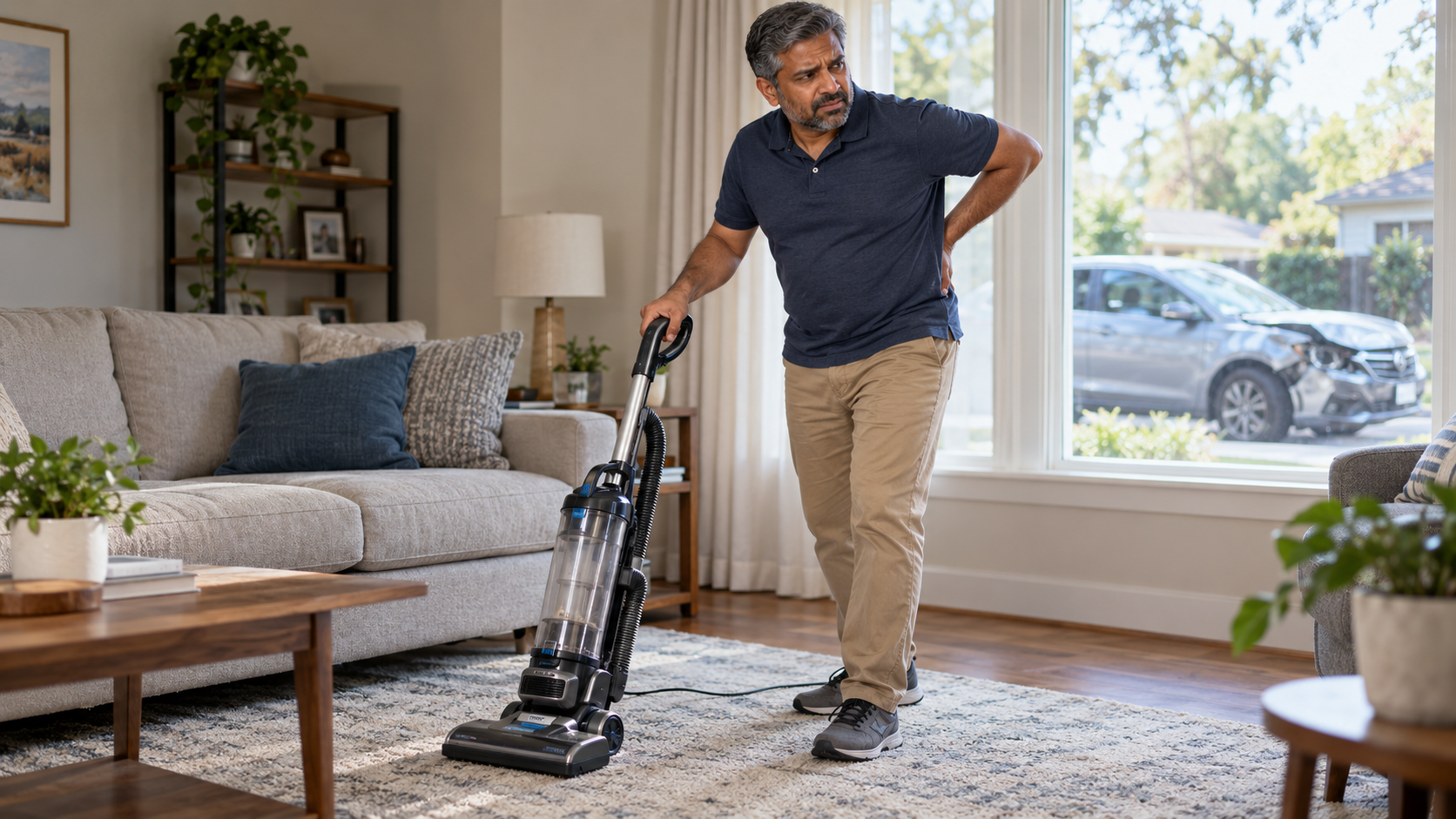
Difficulty Vacuuming After a Car Accident: Back, Shoulder, and Mobility Considerations
Difficulty vacuuming after a car accident can occur because the task combines pushing, pulling, reaching, trunk rotation, walking, and repeated arm movement. Pain in the back, neck, shoulder, wrist, hip, or leg may make the task uncomfortable even when simpler activities are manageable. Persistent functional limitations should be evaluated, especially when accompanied by weakness, numbness, severe pain, or balance problems.
Why Can Vacuuming Trigger Post-Accident Pain?
Vacuuming repeatedly moves a load away from and back toward the body. The vacuum must be pushed away, pulled back, redirected, and advanced across the room while the person continues to grip the handle and move the feet. These actions require coordination between the shoulder and arm, spine, hips, and legs.
Possible contributors include:
- Lower back pain or upper-back pain
- Shoulder or arm injury
- Neck pain with repeated reaching
- Wrist or hand pain while gripping
- Hip or leg pain during stepping
- Muscle fatigue or reduced endurance
- Painful trunk rotation
- Balance problems
A heavy vacuum, long reach, stairs, and prolonged cleaning can increase the demand. A heavier vacuum increases the resistance that must be controlled through the arm, shoulder, trunk, and legs. A long reach places the equipment farther from the body and can increase shoulder and back demand.
Related problems may show up when pushing a shopping cart or reaching into cabinets. Describe which part of the movement causes symptoms rather than assuming every painful task has the same cause.
When Should You Stop the Activity?
Stop and seek appropriate evaluation when activity causes severe or rapidly worsening pain, new weakness, significant numbness, marked dizziness, or loss of safe control of the equipment.
Urgent neurological or post-traumatic warning signs should not be treated as routine exercise soreness. Warning signs are especially important when symptoms affect safe control of the equipment or the ability to walk and turn while cleaning. New weakness or significant numbness can interfere with grip or leg control, while marked dizziness can increase fall risk.
Get urgent medical care for severe shoulder pain after an injury, inability to move the arm, major swelling or deformity, persistent tingling or loss of feeling. Back pain with new bladder or bowel changes, numbness around the groin or rapidly worsening leg weakness needs emergency assessment. Call 911 for severe symptoms or if you cannot reach emergency care safely.
How Can Vacuuming Be Modified During Recovery?
When medically appropriate:
- Work in shorter sessions
- Keep the vacuum closer to your body
- Take smaller steps instead of twisting through the trunk
- Avoid carrying heavy equipment on stairs
- Use help for areas that exceed your current capacity
Temporary modification can reduce demand while function is being restored. Shorter sessions reduce the duration of repeated pushing, pulling, gripping, and stepping. Keeping the vacuum closer can reduce long reaching, while smaller steps can decrease the need for forceful trunk rotation.
Review safe lifting before carrying equipment, and ask for help moving a vacuum between floors. If standing at a counter also causes symptoms, tell your clinician how long you can comfortably remain upright.
Should You Push Through Soreness to Build Strength?
Mild muscular effort and severe or worsening injury symptoms are not the same. Do not use a household chore as a test of how much pain you can tolerate. Activity progression should match the injury and clinical guidance.
A cleaning task should not replace prescribed home exercises. Ask your clinician which activities are suitable, how much to do and which symptoms mean you should stop. A shorter cleaning session may be appropriate for one person while another needs temporary assistance.
How Is This Functional Limitation Evaluated?
A clinician may assess shoulder and arm function, grip, spinal and hip movement, leg strength, balance, and the pushing or pulling motions that reproduce symptoms. The assessment can relate these findings to the exact movement that reproduces symptoms. Shoulder and arm function affect pushing and pulling, grip influences control of the handle, and spinal and hip movement contribute when the person reaches, bends, or changes direction.
For your first chiropractic visit, note whether pushing, pulling, gripping, bending or prolonged cleaning is hardest. Bring relevant medical records and discuss questions to ask your chiropractor, including whether other medical care is needed before activity progresses.
Recovery and Rehab for Difficulty Vacuuming
Rehabilitation may progress strength, mobility, endurance, balance, and pushing or pulling capacity. Functional tasks can be reintroduced gradually as movement becomes safer and more comfortable. Functional progress can be considered in relation to both the duration of cleaning and the amount of resistance, reach, or rotation involved.
Your treatment plan should relate exercises to the household tasks you need to regain. Injury rehab may address the movement limits found during examination. Measure recovery progress through steadier movement, better equipment control and improved tolerance without sharp or worsening pain.
How T98 Rehab Can Help
T98 Rehab can evaluate musculoskeletal limitations affecting household tasks after an auto accident and develop rehabilitation around practical daily goals. Significant neurological findings, suspected fractures, or severe balance problems require appropriate medical evaluation. The evaluation can focus on the same functions required for household cleaning, including shoulder and arm motion, grip, spinal and hip movement, leg strength, gait, balance, and endurance.
When appropriate, chiropractic care can form part of a broader rehabilitation plan. It does not replace assessment for a fracture, serious nerve symptoms or severe balance problems. After urgent concerns are addressed, book an appointment if pain continues to interfere with cleaning and daily activity.
Frequently Asked Questions
Why does vacuuming hurt when walking does not?
Vacuuming adds pushing, pulling, reaching, gripping, and trunk movement to walking, increasing the physical demand. Walking by itself mainly requires gait, lower-body control, and balance, while vacuuming adds resistance through the arms and requires repeated coordination between the upper body, trunk, and legs. The person may also bend, rotate, change direction, or reach farther than during ordinary walking.
Can shoulder injuries make vacuuming painful?
Yes. Repeated forward and backward arm movement can aggravate an injured shoulder or surrounding tissues. The shoulder repeatedly controls the arm as the vacuum moves forward and backward, often while the hand maintains a grip on the handle.
Is twisting while vacuuming a problem?
Forceful or repeated twisting may provoke symptoms after injury. Smaller steps can sometimes reduce rotational demand. Smaller steps can allow the feet and hips to reposition the body instead of relying on repeated trunk rotation while the vacuum remains at a distance.
Should someone else vacuum while I recover?
If the task cannot be performed safely or causes significant symptoms, temporary assistance may be appropriate. Temporary assistance can reduce exposure to movements or loads that are not yet safe or tolerable. This may be especially appropriate when stairs, heavy equipment, significant balance problems, or severe symptoms are involved.
When should I contact T98 Rehab?
After urgent injuries have been excluded, contact T98 Rehab if pain or limited function continues to interfere with household activities. Continued difficulty with vacuuming is useful to report because the task combines repeated arm movement, grip, spinal and hip motion, stepping, balance, and endurance. Describing whether pushing, pulling, reaching, turning, or prolonged cleaning causes the greatest difficulty can help focus the evaluation on the functions that remain limited.
Sources
- NHS: Back pain
- NHS: Shoulder pain
- Health and Safety Executive: Pushing and pulling loads — general handling principles; not an individual rehabilitation program.
Medical Disclaimer
This article provides general education and does not diagnose an injury or replace an individual examination, treatment plan or emergency care. Symptoms after a car accident can have several causes. Seek appropriate medical assessment before resuming painful or unsafe activities. Call 911 for an emergency.