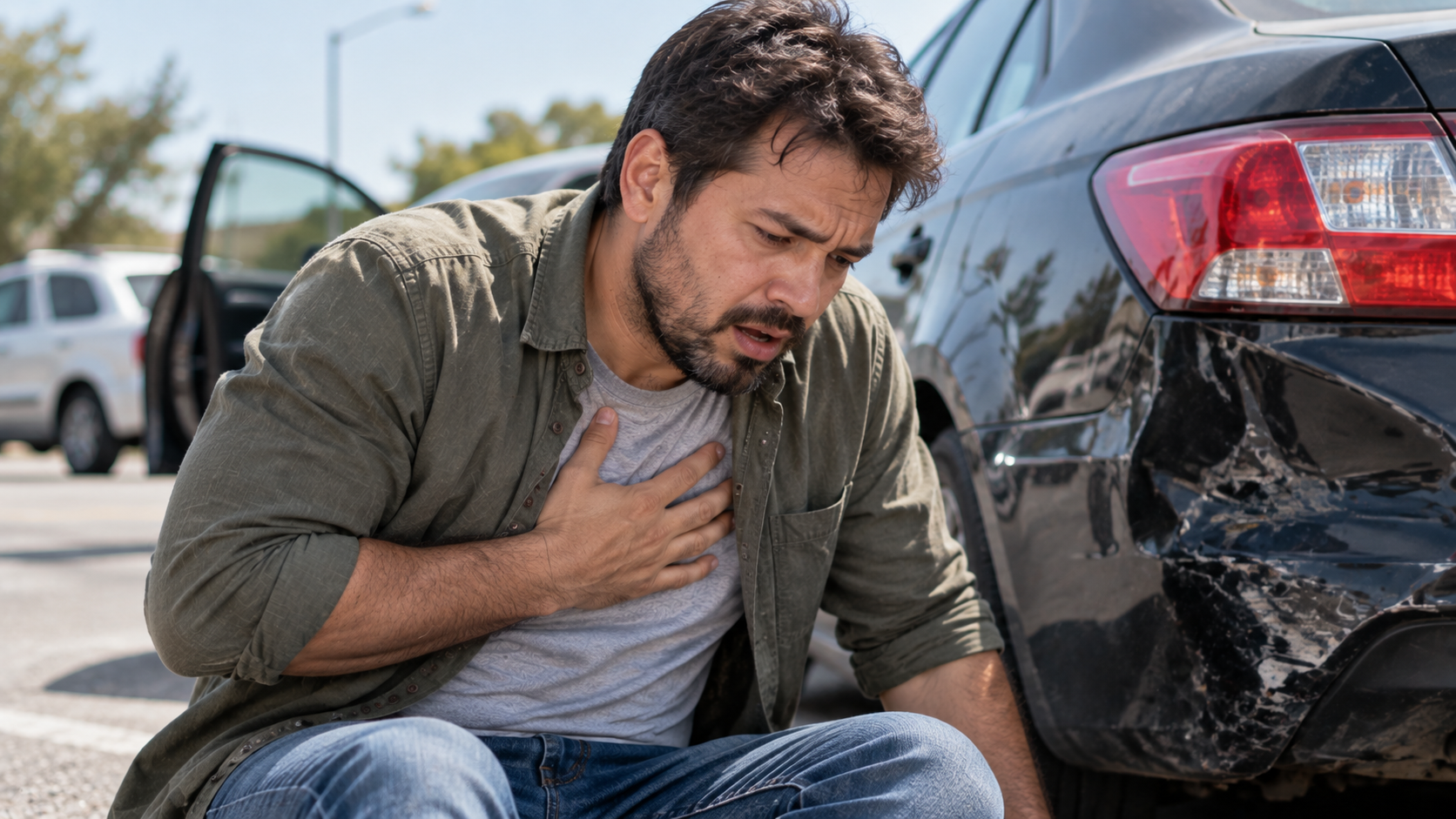
Pain When Breathing After a Car Accident: When to Seek Care
Pain when breathing after a car accident can be caused by chest-wall bruising, strained muscles between the ribs, a rib injury, or other trauma. However, pain with deep breathing can also signal a collapsed lung or another serious chest problem. If you have shortness of breath, severe or worsening chest pain, fainting, blue or gray lips, or cough up blood, call 911 or seek emergency care immediately. Do not assume breathing-related pain is merely muscle soreness or wait for a chiropractic appointment.
Why Does It Hurt to Take a Deep Breath After a Car Accident?
Seat belts, airbags, direct impact, and sudden body movement can injure tissues around the ribs and chest. Chest discomfort may occur alongside back pain after a car accident or other full body soreness after a car accident, but the underlying cause needs evaluation.
- Chest-wall bruising: Soft tissues can become tender after contact with restraints or the vehicle interior.
- Intercostal muscle strain: Injured muscles between the ribs may hurt when the rib cage expands.
- Rib or sternum injury: A bruise or fracture may produce pain with inhaling, coughing, or movement.
- Lung injury: Pneumothorax (collapsed lung) or pulmonary contusion can cause serious breathing symptoms after trauma.
- Other medical emergencies: Heart, vascular, or pulmonary embolism-related problems may also cause chest pain or breathing difficulty.
Because these conditions can overlap in how they feel, pain that changes with breathing does not prove that the cause is muscular.
When Is Chest Pain After a Car Accident an Emergency?
Seek emergency assessment for breathing difficulty, severe or increasing chest pain, rapid breathing, fainting, confusion, blue or gray lips, coughing blood, or major chest trauma. Sudden chest symptoms with unexplained leg swelling may also be concerning. Even without these red flags, new or significant pain with breathing after a collision warrants prompt medical evaluation to rule out internal injuries.
A patient with suspected lung, heart, or internal chest injury needs medical care first. Chiropractic treatment and exercise should not delay emergency evaluation.
Can Seat Belt Injuries Cause Pain When Breathing?
Yes. Restraint forces can bruise the chest wall and contribute to rib or muscle injury. Explore seat belt injuries after a car accident for more context. A seat belt mark or tenderness alone cannot rule out deeper injury; describe the impact and any chest or abdominal symptoms to a clinician.
Why Does My Chest Hurt When I Cough, Twist, or Move?
Movement of the ribs, chest wall, and trunk may aggravate strained muscles or injured ribs. For example, pain when twisting after a car accident can accompany upper-back or chest-wall discomfort. Nevertheless, pain made worse by movement or touch is not a reliable way to exclude dangerous causes of chest pain after trauma.
Can Breathing-Related Pain Start Hours After a Crash?
Yes. Swelling, bruising, and certain injuries may become noticeable later. Read about delayed pain after a car accident. New or worsening pain when inhaling, particularly if accompanied by shortness of breath, should be assessed promptly rather than treated as ordinary delayed soreness.
How Do Doctors Evaluate Pain With Deep Breathing After a Collision?
A medical professional may review the crash mechanism and symptoms, check oxygen levels and vital signs, listen to the heart and lungs, and examine the chest for tenderness, bruising, or abnormal movement. Chest X-rays, CT imaging, electrocardiography, or other testing may be needed based on clinical findings. The testing and treatment depend on whether the issue involves the chest wall, ribs, lungs, heart, or another structure.
For planning a follow-up visit once urgent problems have been addressed, review questions to ask a personal injury care provider and medical documentation after an injury.
Should You Exercise or Take Shallow Breaths to Avoid Pain?
Do not exercise through unexplained chest pain or breathlessness. Repeatedly taking shallow breaths to avoid pain is also not a substitute for treatment, as reduced ventilation can contribute to complications with some chest injuries. Obtain medical guidance about pain control, breathing exercises, movement, and any restrictions; do not self-prescribe chest or rib manipulation after trauma.
Can Chiropractic Rehabilitation Help After a Chest Injury?
When a physician has excluded or treated serious chest conditions and confirms that activity is appropriate, an individualized rehabilitation care plan may help with associated upper-back, shoulder, and trunk mobility limitations. The goal is to restore safe movement without compromising breathing. Rehabilitation timing and techniques must follow the diagnosis, and suspected rib fractures or internal injuries require medical direction.
T98 Rehab can evaluate appropriate musculoskeletal complaints after medical clearance and coordinate referrals when needed. Learn when to see a chiropractor after a car accident and how recovery milestones are set; neither resource replaces evaluation for post-traumatic chest pain.
Frequently Asked Questions
Is it normal for my ribs to hurt when breathing after a car accident?
Rib and chest-wall injuries can cause this symptom, but significant pain when breathing after trauma needs medical assessment because lung or other internal injuries can feel similar.
Can a seat belt bruise cause pain with a deep breath?
Yes, but a bruise does not rule out rib fracture or deeper injury. Seek appropriate medical evaluation.
What if I have chest pain but no shortness of breath?
Absence of breathlessness does not exclude serious injury. New or significant chest pain after a crash should be medically assessed promptly.
Can pain when breathing appear the next day?
Yes. Symptoms may emerge or worsen later, which is another reason not to dismiss new breathing-related pain after a collision.
Should I visit a chiropractor for chest pain after a car accident?
Medical evaluation comes first to rule out serious chest and breathing conditions. Chiropractic rehabilitation may be considered afterward only for appropriate musculoskeletal symptoms.
Related T98 Rehab Resources
- Difficulty Driving After a Car Accident
- Returning to Activity After an Injury
- How to Choose an Auto Accident Chiropractor in Austin
Sources
MedlinePlus, U.S. National Library of Medicine — Chest Injuries and Disorders.
Centers for Disease Control and Prevention — Blood Clots.
National Heart, Lung, and Blood Institute — Pneumothorax.
Medical Disclaimer
This article is for general educational purposes and is not an individual diagnosis or a substitute for emergency care or advice from a licensed medical professional. T98 Rehab does not provide emergency services or guarantee clinical outcomes. New or significant chest pain following a crash should be medically evaluated promptly; call 911 for severe pain, breathing difficulty, fainting, or other emergency symptoms.