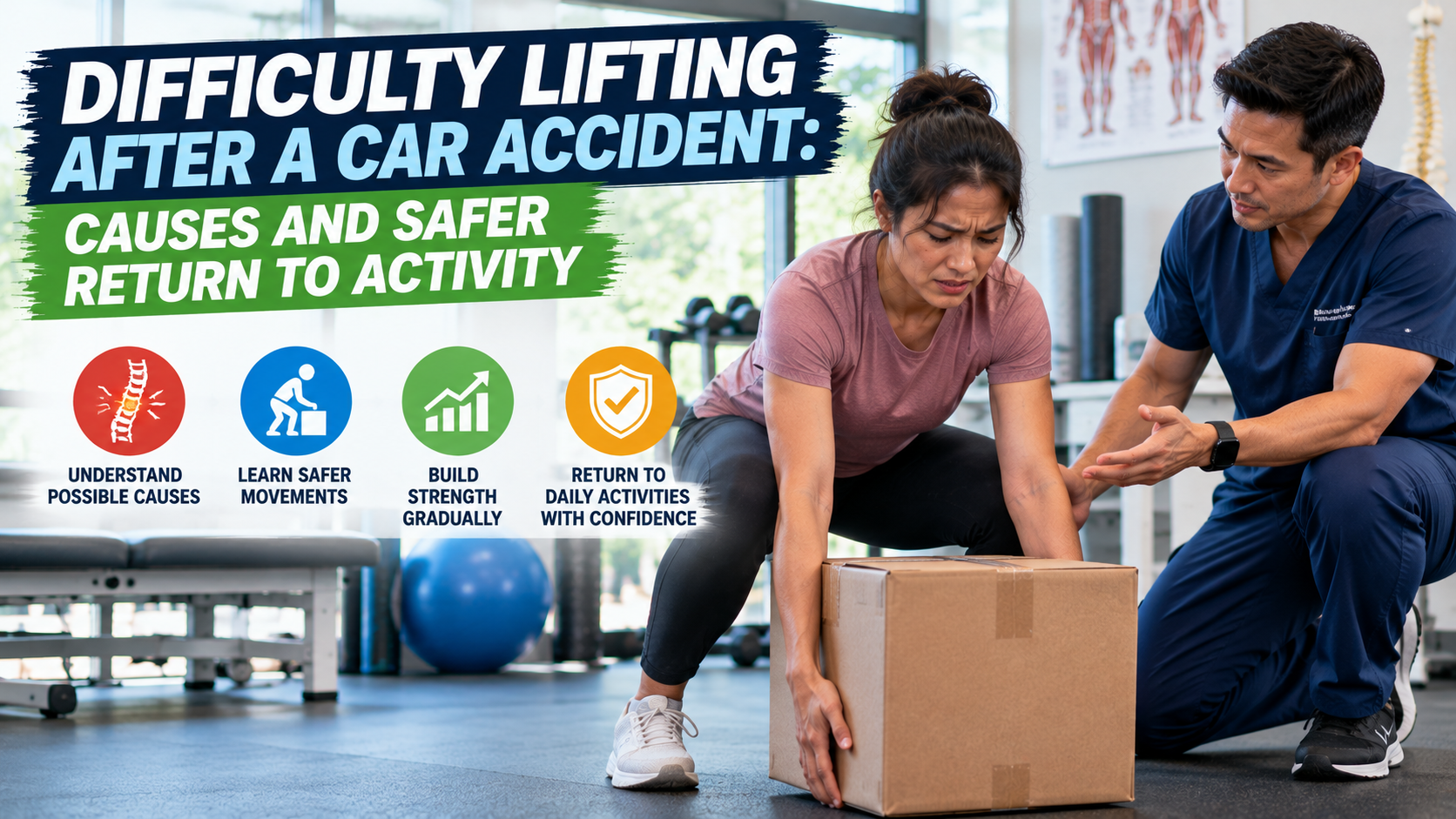
Difficulty Lifting After a Car Accident: Causes and Safer Return to Activity
Difficulty lifting after a car accident can result from injuries involving the back, neck, shoulders, arms, wrists, hips, or legs. Lifting combines strength, grip, balance, bending, and trunk control, so pain or weakness in several areas can affect the task. New major weakness, severe radiating pain, significant numbness, or other neurological warning signs should be evaluated before returning to heavy lifting.
Why Can Lifting Become Difficult After a Car Accident?
Common contributors include:
- Back or neck strain
- Shoulder or arm injury
- Wrist or hand pain that reduces grip
- Hip, knee, or leg pain
- Muscle guarding or spasm
- Nerve-related pain, numbness, or weakness
- General loss of confidence with movement after injury
The weight of an object is only one factor. Reaching distance, height, grip, and repetition can change the demand. Pain when twisting may add another limitation when turning with a load.
When Is Difficulty Lifting a Warning Sign?
Seek urgent medical evaluation for severe pain after significant trauma, major joint deformity, or a cold or discolored limb. New or worsening major weakness, significant numbness, new loss of bladder or bowel control, or numbness around the groin needs emergency assessment. Call 911 for potentially life-threatening symptoms.
Do not test heavy lifting when fracture, significant neurological injury, or another serious condition has not been excluded.
How Is Lifting Difficulty Evaluated?
A clinician may assess spinal and joint motion, strength, sensation, reflexes, grip, balance, and the movements that reproduce symptoms. Evaluation may also consider whether lifting from the floor, waist height, or overhead creates different limitations. Explain any difficulty bending or pain reaching overhead. At your first chiropractic visit, bring available medical reports and describe how the limitation affects work or home tasks.
Imaging or specialist assessment may be appropriate when the examination suggests a significant structural injury.
Should You Avoid All Lifting During Recovery?
Not necessarily. Complete avoidance may not be needed for every injury, but heavy or painful lifting should not be forced. Activity should match the diagnosed injury, current function, and medical guidance. Lower back pain and grip problems may call for different modifications. Review safe lifting with your clinician rather than assuming that a different technique makes an unsuitable load safe.
How Can Lifting Be Reintroduced?
When appropriate, rehabilitation may begin with comfortable movement and basic strength, then progress to light loads, better lifting mechanics, carrying, and job- or home-specific tasks. Load, repetition, and range can be increased gradually according to tolerance and clinical findings. An individualized rehabilitation care plan should specify restrictions and reassessment rather than setting a universal safe weight.
Practical Lifting Goals at Home and Work
Tell your clinician which activities matter most, such as carrying groceries, lifting tools, or carrying a child. These tasks differ in grip, movement, repetition, and the consequences of losing control. Do not use a child or heavy object to test your capacity.
After assessment, temporary strategies may include reducing loads, asking for assistance, avoiding awkward reaches, or changing task height. Follow prescribed restrictions. Stop a task that causes sharp or escalating pain, new numbness, weakness, or unsafe balance.
For work, discuss the actual load, lifting height, frequency, carrying distance, and shift length. Ask whether temporary duties or specific restrictions are appropriate. Keep observations about symptoms and task tolerance for your medical records, and reassess recovery progress at follow-up visits.
How T98 Rehab Can Help
T98 Rehab can evaluate musculoskeletal limitations affecting lifting after an auto accident and develop a progressive rehabilitation plan. Significant neurological symptoms, suspected fractures, or other urgent findings require appropriate medical evaluation first. Recommendations depend on clinical findings, and recovery is not guaranteed.
For non-emergency concerns, request an appointment to discuss an evaluation.
Frequently Asked Questions
Why can I lift a light object but not something from the floor?
Floor lifting requires more bending, hip motion, trunk control, and leverage than lifting an object already at waist height.
Can wrist or hand pain affect lifting?
Yes. Reduced grip strength or pain can make even a relatively light object difficult to control safely.
Should I wear a back brace whenever I lift?
Bracing is not automatically appropriate for every injury. Use a brace only when recommended for your specific condition.
When can I return to heavy lifting at work?
Return depends on the injury, job demands, strength, movement, and medical guidance rather than a fixed number of days.
When should I contact T98 Rehab?
After urgent injuries have been excluded, contact T98 Rehab if pain, weakness, or restricted movement continues to limit lifting at home or work.
Sources
- MedlinePlus — Lifting and Bending the Right Way
- MedlinePlus — Back Injuries
- American Academy of Orthopaedic Surgeons — Lifting Techniques for Home Caregivers
Medical Disclaimer
This article is for general education and does not provide an individual diagnosis, treatment plan, or prognosis. It does not replace evaluation or advice from a qualified healthcare professional. Lifting limits and return-to-activity recommendations depend on your injury, examination findings, and task demands. T98 Rehab does not provide emergency care or guarantee recovery. Seek urgent or emergency medical attention for serious or worsening symptoms after a car accident.