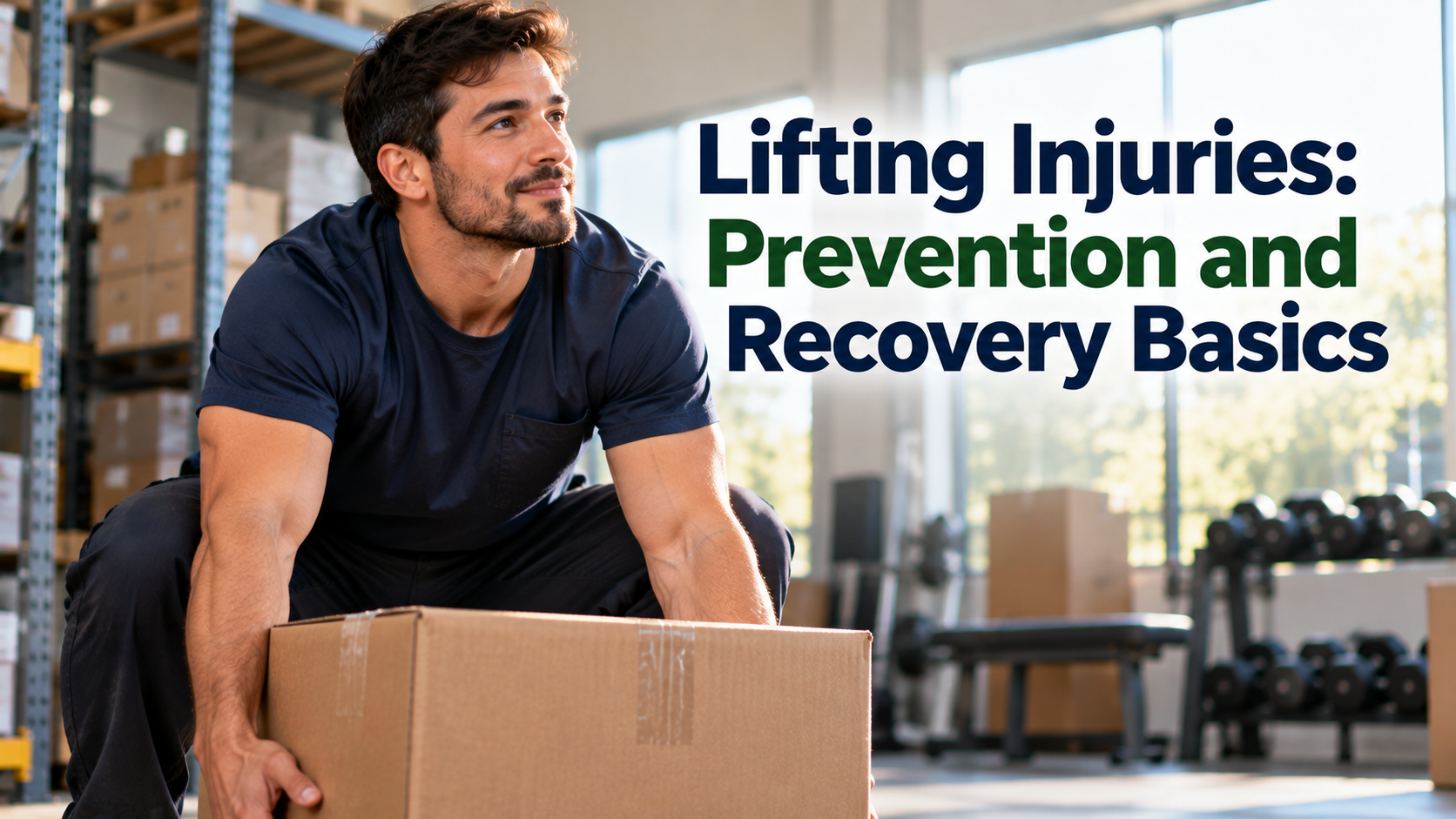
Lifting Injuries: Prevention and Recovery Basics
Lifting injuries can occur at work, in the gym or during ordinary household tasks. Risk is influenced by the load, distance from the body, repetition, twisting, fatigue, footing and whether the task exceeds the person’s current capacity.
Quick answer: Lifting injuries can occur at work, in the gym or during ordinary household tasks. Progress should be based on safety, function and the individual response—not a guaranteed timetable.
Plan the Lift Before You Move
Check the load, route and destination. Test whether the object is stable and whether handles, a cart, team lift or mechanical assistance are available. Clear obstacles and make sure there is space to set the object down without pain when twisting.
If the load is bulky, shifting or beyond safe control, do not treat the lift as a test of strength. Change the method.
Use a Stable, Controlled Strategy
Position yourself close to the object, establish stable footing and keep the load close. Turn with the feet rather than twisting through the trunk while carrying. Use a smooth effort and avoid sudden jerking.
There is no single perfect technique for every object and environment. The task should be adapted to the person, load and available equipment.
Fatigue and Repetition Matter
Lifting injuries can become more likely when a load that feels manageable once becomes difficult after repeated lifts. Work rate, recovery time, reaching distance and asymmetrical positions affect exposure. Rotate tasks or use assistance where feasible.
At the gym, avoid increasing weight, sets and frequency at the same time. Technique should remain controlled as fatigue develops.
Lifting Injuries: What to Do After a Flare
Stop the provoking task and check for warning signs. For a mild musculoskeletal flare without red flags, relative activity and comfortable movement may be preferable to prolonged bed rest, but individual conditions differ.
injury documentation should record what was lifted, the position, immediate symptoms and any later changes. Seek evaluation if symptoms are severe, persistent, recurrent or function-limiting.
Urgent Warning Signs
• New loss of bladder or bowel control or numbness around the groin.
• Rapidly increasing weakness, widespread numbness and tingling or difficulty walking.
• Severe pain after major trauma or a suspected fracture.
• Chest or abdominal pain, fainting or breathing difficulty.
• Fever, unexplained weight loss or serious illness accompanying back pain.
Return to Lifting Gradually
Recovery from lifting injuries should begin with predictable loads and controlled ranges. Restore tolerance for the component movements before full job or training demands. Increase one variable at a time and monitor the response over the next day.
returning to activity after an injury may involve work restrictions that address maximum load, lift frequency, floor-level lifting, overhead work, carrying distance or twisting. Restrictions should be specific and reassessed.
A Pre-Lift Checklist
• Do I know the approximate weight and stability of the load?
• Is the route clear and destination ready?
• Can I keep the object reasonably close?
• Would a cart, team lift or mechanical aid be safer?
• Am I too fatigued, rushed or symptomatic to perform this lift safely?
How T98 Rehab Can Help
T98 Rehab & Chiropractic provides non-emergency musculoskeletal evaluation and rehabilitation for people recovering from car, truck, motorcycle, boating, workplace, sports and everyday injuries. Care recommendations may follow an individualized rehabilitation care plan and may include education, therapeutic exercise, mobility work, manual approaches, activity modification, recovery milestones and referral when another level of care is appropriate.
For accident-related care, the team can help patients organize relevant medical records and communicate with authorized insurers or legal representatives. T98 does not provide legal advice, determine fault, value claims or guarantee medical or legal outcomes.
Schedule at One of Three Austin-Area Locations
• North Austin — 1139 Braker Lane #101, Austin, TX
• South Austin — 2512 S. I-35 Frontage Road #260, Austin, TX
• Pflugerville — 201 N. Heatherwilde Boulevard #104, Pflugerville, TX
Call 512-614-2330 to schedule a chiropractic appointment.
Frequently Asked Questions
Should I stay in bed after a back strain?
Prolonged bed rest is generally not the goal for uncomplicated back pain. Comfortable activity may be appropriate, but red flags and individual medical advice matter.
When can I return to heavy lifting?
Return when the required movement, strength, control and repeated-load tolerance have been rebuilt and your provider has addressed relevant restrictions.
Is a lifting belt enough to prevent injury?
A belt does not replace task design, manageable loads, assistance, technique, recovery and appropriate conditioning.
What if pain travels into my leg?
sciatica symptoms such as radiating pain, numbness or weakness can indicate nerve involvement and should be discussed with a qualified provider, urgently if severe or progressive.
When to Seek Emergency Care
Call 911 or seek emergency care for life-threatening symptoms, severe or rapidly worsening neurological changes, loss of consciousness, chest pain, serious breathing difficulty, uncontrolled bleeding, suspected fracture or another medical emergency. This article is not a substitute for diagnosis or individualized treatment.
Related T98 Rehab Resources
- difficulty lifting after a car accident
- back pain after a car accident
- injury recovery
- home exercise safety
- rehabilitation care plan
- chiropractic appointment
Sources
Medical Disclaimer
This content is for general educational purposes only. It does not establish a clinician-patient relationship and should not be used to diagnose a condition or replace advice from a qualified healthcare professional. Treatment, exercise and return-to-activity decisions should be individualized.