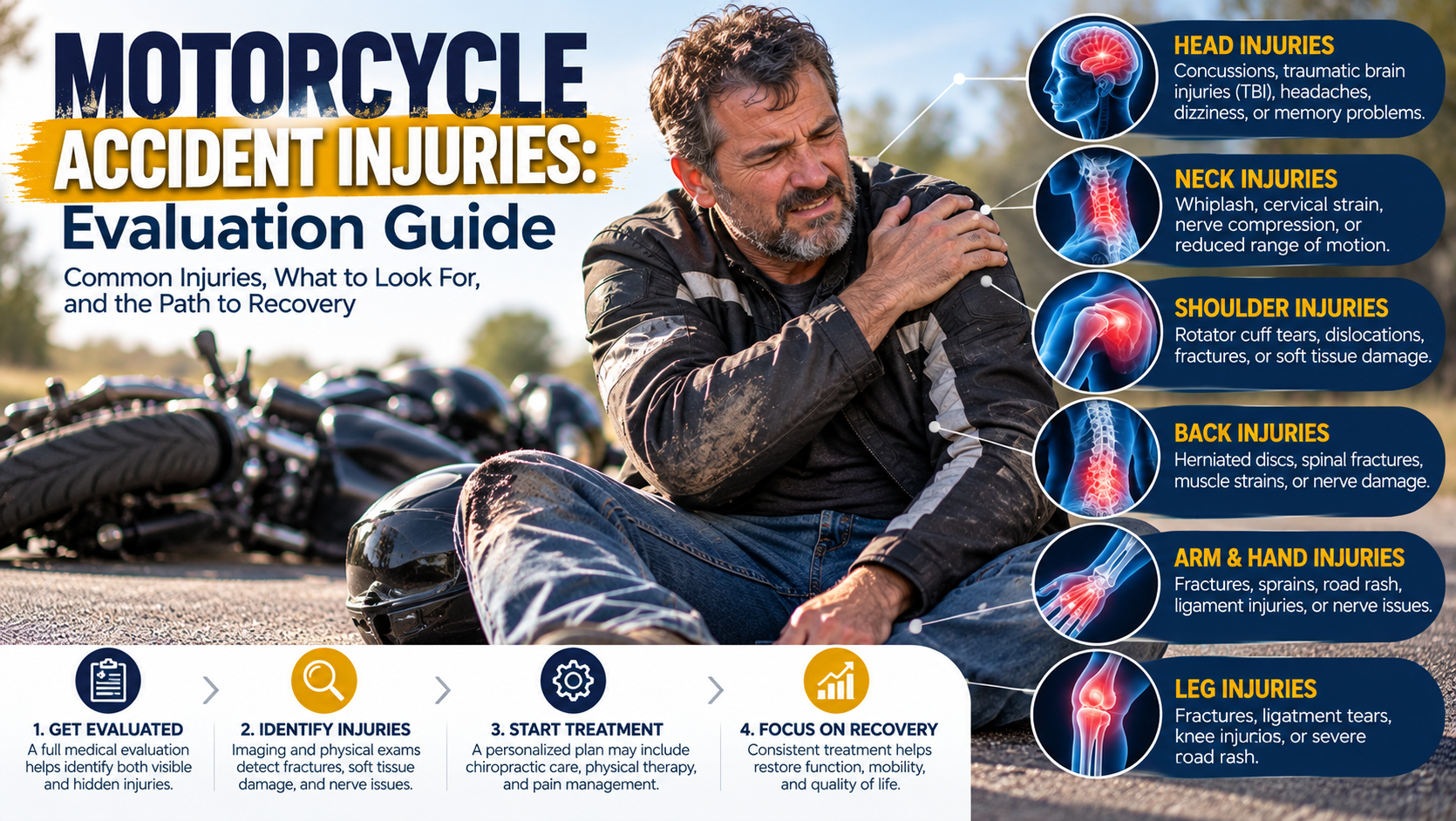
Motorcycle Accident Injuries: Evaluation Guide
Motorcycle accident injuries can involve more than the area that hurts most. This guide explains emergency warning signs, follow-up evaluation and rehabilitation after urgent injuries have been addressed.
Motorcycle Accident Injuries: The First Priority
Because riders have less physical protection, a motorcycle crash can cause head, spine, chest, abdominal, skin, bone and joint injuries. Emergency evaluation is essential after significant impact or concerning symptoms. Once urgent injuries have been treated, a clinician can assess remaining neck, back, shoulder, hip, knee or movement problems and determine whether rehabilitation is appropriate.
A motorcycle crash can involve several injury mechanisms at the same time. A rider may experience direct impact, rapid body movement, sliding or bracing against the motorcycle. For that reason, the first priority is identifying injuries that require emergency or medical care before considering non-emergency rehabilitation.
When Motorcycle Accident Injuries Need Emergency Care
- Call 911 for loss of consciousness, confusion, seizure, repeated vomiting or worsening headache.
- Seek emergency help for breathing difficulty, chest or abdominal pain, uncontrolled bleeding or deep road rash.
- Do not attempt to straighten a deformed limb or remove embedded material.
- Treat severe neck or back pain, weakness, numbness and tingling, or loss of coordination as urgent.
- Follow emergency guidance about helmet removal when a spinal injury is possible.
A rider can have a serious injury even if able to stand or speak after the crash. Do not use pain intensity alone to decide that emergency care is unnecessary.
The circumstances of the crash also matter. A significant impact can expose the head, spine, chest, abdomen and extremities to forces that are not always reflected by the first symptoms a rider notices. Emergency professionals are equipped to evaluate acute trauma and determine whether imaging, wound care, observation or other treatment is needed.
If emergency care has already been provided, follow the discharge instructions and any restrictions that were given. New, worsening or unexpected symptoms should be reported to the appropriate medical professional rather than assumed to be part of a routine musculoskeletal recovery.
Neck, Back and Joint Pain After a Motorcycle Crash
After emergency injuries are addressed, common concerns include neck pain, lower back pain and pain in the shoulders, wrists, hips, knees or ankles. Direct impact, sliding, bracing against the handlebars or rapid body movement can contribute. headache after an accident, dizziness or concentration changes need medical evaluation because they may be associated with concussion.
Once urgent injuries have been addressed, remaining symptoms may affect ordinary tasks such as difficulty walking, turning your head, reaching, gripping, lifting, getting in and out of a vehicle or returning to work. The location of pain alone does not establish which structure is involved, so an examination should consider both symptoms and function.
A rider should also mention changes that may not seem directly related to the most painful area. Weakness, numbness, balance problems or changes in coordination can affect the level of care that is appropriate and may require further medical assessment.
What to Bring to Your Motorcycle Injury Evaluation
- Emergency or urgent-care discharge instructions.
- Imaging reports and access to available images.
- Medication and surgery information.
- A timeline of symptoms and functional limits.
- Work restrictions and questions about driving or riding.
Bringing available medical records helps the evaluating provider understand what has already been assessed and which restrictions are currently in place. A simple symptom timeline can include when symptoms began, whether they have changed since the crash and which daily activities remain difficult.
Medication information matters when discussing driving or riding. Some medicines can affect alertness, balance and reaction time. Follow the prescribing professional’s instructions and ask the appropriate clinician whether a medicine could impair safe riding.
How Motorcycle Accident Injuries Are Evaluated
The provider may evaluate range of motion, strength, reflexes, sensation, balance, gait and task tolerance. The goal is not merely to name a painful area; it is to identify whether findings are suitable for conservative care, require modification or need referral.
The examination can be adapted to the injuries already identified and the rider’s current limitations. For example, a provider may look at how comfortably the patient moves the neck and shoulders, whether walking and balance are affected, or whether strength and sensation appear altered. The specific examination should be individualized. If chiropractic evaluation is appropriate, learn what to expect at your first chiropractic visit and prepare questions to ask your chiropractor.
Referral remains part of appropriate care when findings fall outside a non-emergency musculoskeletal setting. Rehabilitation should not replace medical or specialty care that is needed for injuries identified during the crash evaluation or during follow-up.
Rehab Goals After Motorcycle Accident Injuries
Early injury rehab may focus on comfortable movement, swelling management within medical guidance and restoring basic daily function. Later work may address strength, endurance, balance and job or recreation demands. A rider should not return to a motorcycle simply because pain has decreased.
Progress can be organized around goals for recovery progress rather than a guaranteed recovery date. Early milestones may involve tolerating basic movement and daily activities. Later milestones may involve improved strength, balance, endurance and the ability to perform tasks that more closely resemble work or recreation.
Your treatment plan should respond to the individual’s examination and progress. If symptoms worsen substantially, new neurological symptoms appear or function declines, reassessment may be needed before increasing activity. Ask which home exercises are appropriate and what changes mean you should stop.
When Can You Ride Again After a Motorcycle Accident?
Safe riding requires alertness, balance, coordination, grip, shoulder and neck motion, lower-extremity control and the ability to react quickly. Sedating medication, dizziness, limited head rotation, weakness or impaired braking and shifting are reasons to delay riding and discuss readiness with the treating professional.
Return-to-riding is therefore more than a question of whether pain has improved. A rider needs to be able to scan the environment, control the handlebars, operate braking and shifting controls, maintain balance and respond quickly to changing conditions. A limitation in any of these areas can affect safe motorcycle operation.
Readiness should also account for medical restrictions. If a treating professional has limited driving, lifting, weight bearing or another activity, those restrictions should be resolved or specifically addressed before riding resumes. Discuss clearance with your treating professional; a fixed number of days does not establish that riding is safe.
A gradual return plan may begin only after the rider can safely perform the necessary tasks and the treating professional considers riding appropriate. Symptoms that return or worsen as activity increases should be discussed rather than ignored. Follow an individual plan for exercise after an injury before attempting more demanding activity.
Motorcycle Helmets, Protective Gear and Safety
NHTSA recommends a DOT-compliant helmet and protective clothing. Replacing damaged safety equipment, reviewing the motorcycle and practicing only after clinical clearance can be part of a thoughtful return plan. Prevention guidance does not replace evaluation of an existing injury.
Protective equipment is part of risk reduction, not proof that an injury is minor. After a crash, damaged equipment should be addressed before returning to riding, and the motorcycle itself should be reviewed as appropriate. These practical steps belong after immediate medical and recovery needs have been considered.
Medical Records, Insurance and Coordinating Care
Maintain consistent records of symptoms, appointments, restrictions and progress. T98 can coordinate authorized clinical information with insurers or legal representatives but does not establish fault, claim value or legal strategy. Coordinating care after an accident helps clarify who handles treatment, billing questions and authorized communication.
Useful records can include discharge instructions, imaging reports, appointment information, work restrictions and notes about functional changes. Consistency is important because different professionals may be involved at different stages of care.
Clinical documentation should remain focused on healthcare. Insurance coverage questions should be directed to the appropriate insurer or clinic billing contact, while legal questions belong with a qualified attorney. Keeping those roles distinct helps avoid confusing medical recommendations with insurance or legal advice.
Motorcycle Injury Care at T98 Rehab
T98 Rehab & Chiropractic provides non-emergency musculoskeletal evaluation and rehabilitation following motorcycle and other vehicle accidents, with referral when medical or specialty care is needed. If chiropractic care is considered, discuss chiropractic safety, risks, alternatives and whether the injuries require another form of care.
For an appropriate non-emergency case, care can focus on the movement and functional limitations identified during evaluation and on measurable progress toward daily, work or recreation goals. When the examination indicates that another level of care is needed, referral or coordination is part of the process.
Book an Injury Evaluation in Austin or Pflugerville
- North Austin – 1139 Braker Lane #101, Austin, TX
- South Austin – 2512 S. I-35 Frontage Road #260, Austin, TX
- Pflugerville – 201 N. Heatherwilde Boulevard #104, Pflugerville, TX
Call 512-614-2330 or book an appointment for non-emergency follow-up care. Confirm chiropractic costs and insurance coverage before your visit.
Motorcycle Accident Injuries: Frequently Asked Questions
Can I have a concussion without losing consciousness?
Yes. Loss of consciousness is not required. Headache, confusion, memory problems, dizziness, vomiting or worsening symptoms require medical evaluation.
When can I ride again?
Return only when medical restrictions are resolved and you can safely perform all riding tasks without impaired alertness, control or reaction.
Is chiropractic care appropriate after every motorcycle crash?
No. Suitability depends on the injuries, medical clearance, examination and technique. Some patients require other care first or instead.
Does less pain mean I am ready to ride?
Not necessarily. Less pain alone does not establish that riding is safe. Alertness, balance, coordination, grip, neck and shoulder movement, leg control and reaction ability also matter. Follow your treating professional’s restrictions.
What if dizziness or concentration problems continue?
Headache, dizziness and concentration changes require medical consideration because they may overlap with concussion. Persistent or worsening symptoms should be discussed with the appropriate medical professional.
Related T98 Rehab Resources
- medical documentation after an injury
- rehabilitation care plan
- recovery milestones
- return to activity after injury
- personal injury care
Sources
- NHTSA: Motorcycle Safety — helmets, protective clothing, rider control and impairment risks.
- CDC: Symptoms of Mild TBI and Concussion — symptoms and danger signs requiring emergency medical care.
- NCCIH: Spinal Manipulation: What You Need To Know — treatment considerations, risks and questions for healthcare providers.
Medical Disclaimer
This article provides general education and does not establish a clinician-patient relationship or replace emergency evaluation, diagnosis or individualized medical advice. T98 Rehab provides non-emergency care. Treatment suitability, rehabilitation and return-to-riding decisions depend on your injuries, examination, medical restrictions and response to care. Call 911 for serious or rapidly worsening symptoms. No recovery timeline or treatment outcome is guaranteed.