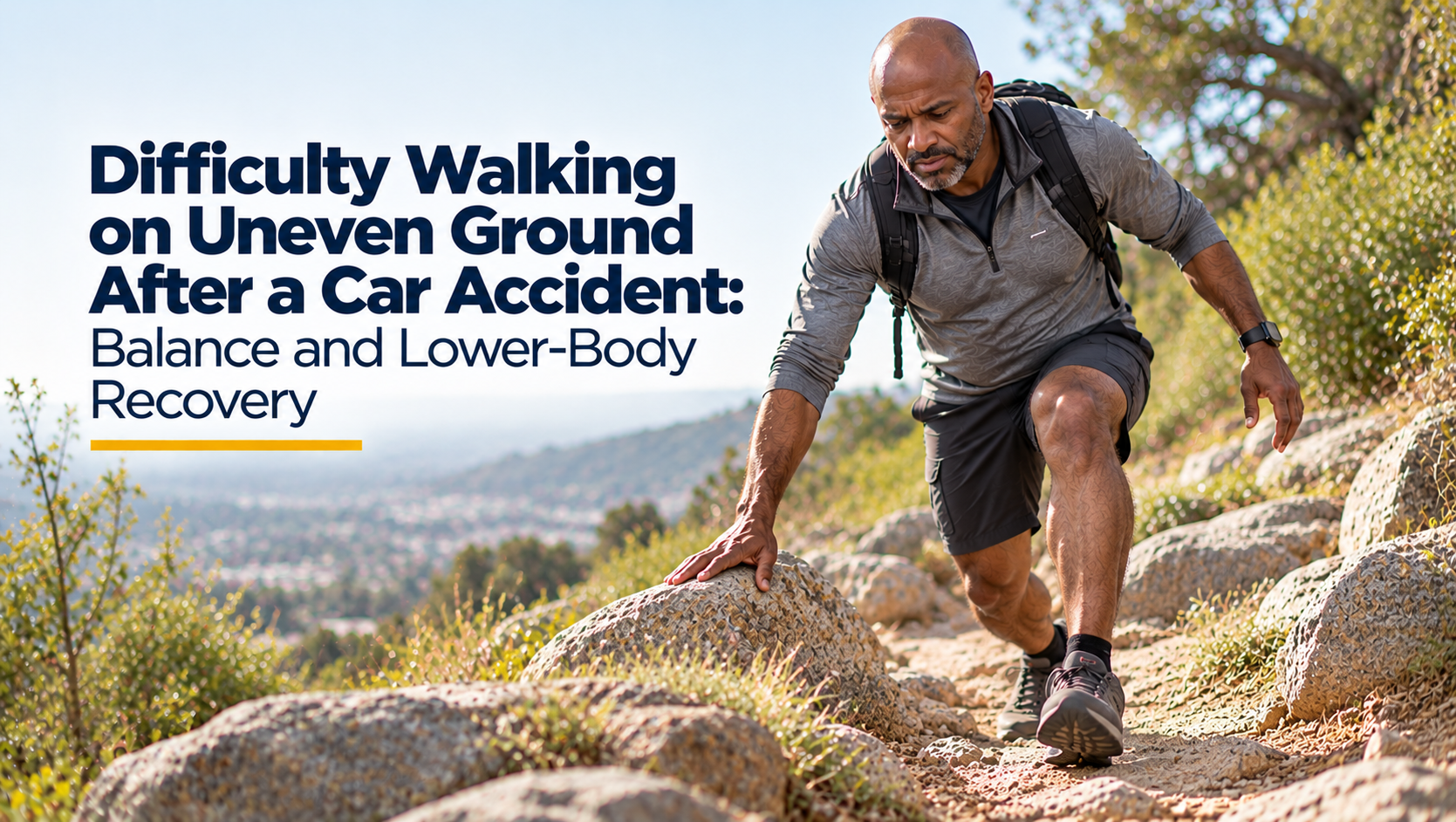
Difficulty walking on grass, gravel, slopes, curbs, or other uneven surfaces after a car accident can reflect problems with balance, ankle or foot function, leg strength, joint mobility, pain, or dizziness. Uneven ground requires constant small adjustments that are not needed on a flat indoor floor, so limitations may appear outdoors even when basic walking seems normal. Significant dizziness, inability to bear weight, rapidly worsening weakness, or major neurological symptoms requires prompt medical evaluation.
Why Can Uneven Ground Be Harder After a Crash?
Uneven surfaces require the body to adapt with every step.
Possible contributors include:
Ankle or foot pain and stiffness
Knee or hip injury
Reduced leg strength
Poor balance or coordination
Back or nerve-related leg symptoms
Dizziness or vestibular symptoms
Altered walking pattern caused by pain
Reduced confidence after injury
The surface itself may expose a deficit that is difficult to notice on smooth flooring.
When Is Walking Instability a Warning Sign?
Seek prompt medical care for sudden or severe balance loss, new weakness, major numbness, inability to bear weight, fainting, severe dizziness with neurological symptoms, or a cold or discolored foot.
New neurological or significant balance symptoms after a collision should not simply be treated as deconditioning.
How Is Uneven-Surface Walking Evaluated?
A clinician may assess gait, balance, ankle and foot function, hip and knee strength, sensation, reflexes, and whether dizziness contributes to instability. The examination may also look at how the person responds to changes in direction and surface demand.
Why Can Grass or Gravel Feel Harder Than a Sidewalk?
Firm, level pavement provides predictable support. Grass, gravel, and sloped surfaces change under the foot and require faster balance corrections, ankle control, and sensory feedback.
Should You Practice on Uneven Ground Right Away?
Not if balance is unsafe or the underlying injury has not been evaluated. Rehabilitation often progresses from stable surfaces to more challenging conditions as strength, control, and confidence improve.
Use appropriate support and avoid environments where a loss of balance could lead to another injury.
Recovery and Rehabilitation
Rehabilitation may address ankle and hip strength, joint mobility, balance, gait control, and tolerance for changing surfaces. Progression can include increasingly realistic walking environments when medically appropriate.
How T98 Rehab Can Help
T98 Rehab can evaluate musculoskeletal and functional limitations affecting walking after an auto accident and develop a progressive rehabilitation plan. Significant dizziness, neurological findings, suspected fractures, or severe instability require appropriate medical evaluation first.
Frequently Asked Questions
Why can I walk indoors but struggle outside?
Outdoor surfaces often require more ankle control, balance, and rapid adjustments than a flat indoor floor.
Can an ankle injury affect balance even if pain is mild?
Yes. Stiffness, weakness, swelling, or altered joint control can affect stability.
Can dizziness contribute to uneven-ground problems?
Yes. Dizziness or vestibular symptoms can reduce balance and should be medically evaluated when significant after a crash.
Should I use a cane or other support?
An assistive device may be appropriate for some people, but selection and fitting should be based on individual needs and professional guidance.
When should I contact T98 Rehab?
After urgent conditions have been excluded, contact T98 Rehab if pain, weakness, stiffness, or balance limitations continue to interfere with safe walking.
Sources
MedlinePlus, U.S. National Library of Medicine, balance, dizziness, and walking information.
American Academy of Orthopaedic Surgeons (OrthoInfo), patient information on ankle, foot, knee, and hip injuries.
This article is educational and does not provide an individual diagnosis or replace emergency or individualized medical care.
Related T98 Rehab Resources
Learn about back pain after a car accident, explore the Resource & Help Center, or schedule a consultation.