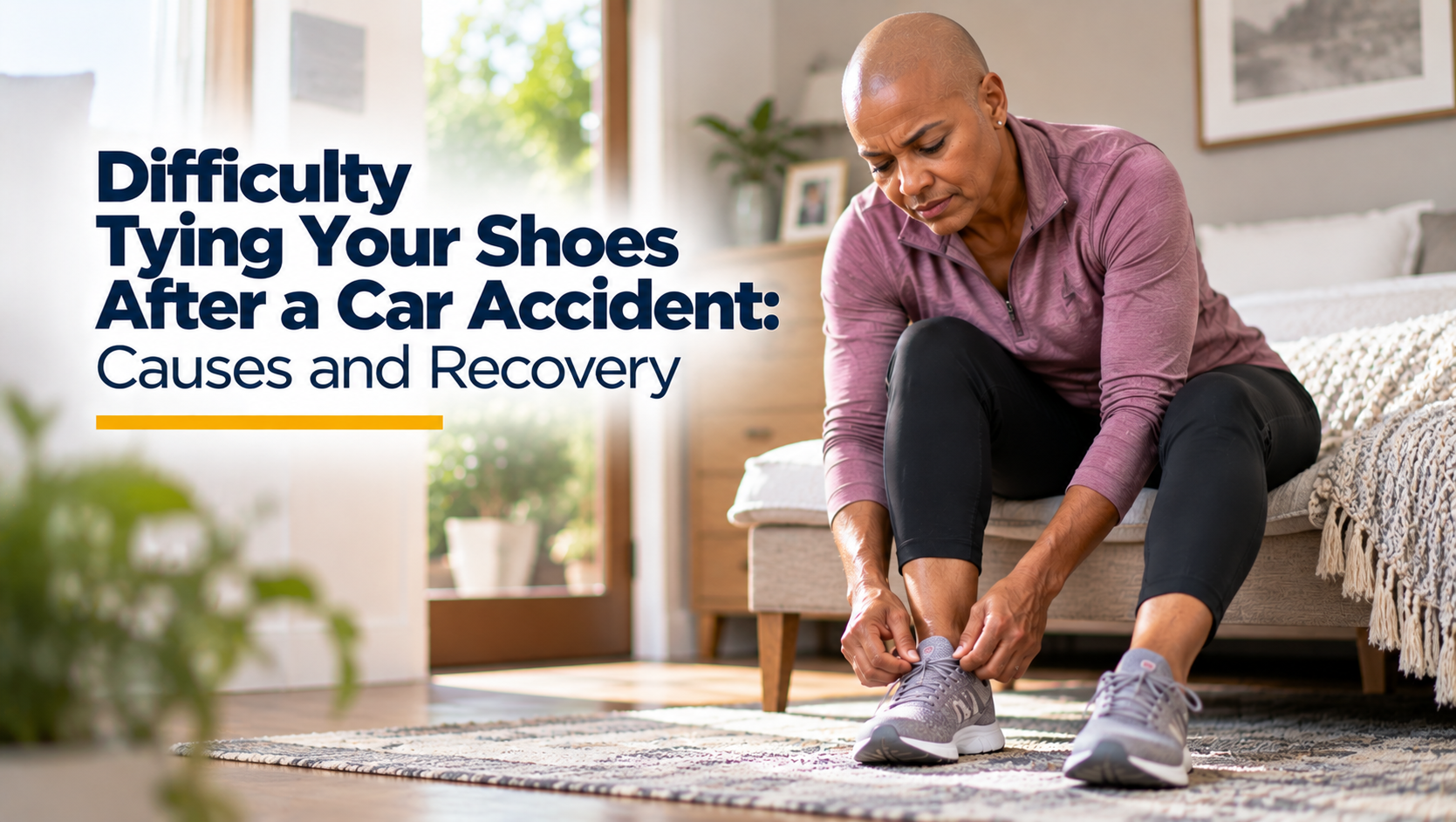
Difficulty tying your shoes after a car accident can reflect limitations in the back, hips, knees, ankles, shoulders, or hands. The task requires bending or bringing the foot closer to the body, maintaining balance, and using both hands for fine movement. Persistent difficulty can be a useful sign of how an injury is affecting everyday function. Severe weakness, major numbness, inability to bear weight, or other neurological warning signs require prompt medical evaluation.
Why Can Tying Shoes Be Difficult After a Crash?
Possible contributors include:
Lower-back pain or stiffness
Hip pain or reduced hip motion
Knee pain when bending the leg
Ankle or foot pain
Shoulder, wrist, or hand pain
Nerve-related pain, numbness, or weakness
Balance problems
Muscle guarding after injury
The position used to reach the shoe can change which area feels limited.
Why Does Bending Toward the Foot Hurt?
Reaching toward the foot can require motion through the spine and hips while the knee bends. If one of these regions is injured or guarded, the movement may become painful or restricted.
Some people compensate by twisting or pulling the leg into a different position, which can shift stress to another area.
When Is This Difficulty a Warning Sign?
Seek prompt medical care for new or worsening leg weakness, major numbness, inability to bear weight, loss of bladder or bowel control, saddle-area numbness, severe swelling, or significant pain after trauma.
Do not force the body into a painful position simply to complete the task.
How Is the Problem Evaluated?
A clinician may assess spinal and hip mobility, knee and ankle motion, balance, strength, sensation, and the movement strategy used to reach the foot. Hand or shoulder function may also be assessed when those areas contribute to the limitation.
How Can the Task Be Modified During Recovery?
When medically appropriate, temporary strategies may include sitting on a stable surface, bringing the foot to a comfortable height, using slip-on footwear, or asking for assistance.
The goal is to reduce unnecessary strain while the underlying limitation is being evaluated and rehabilitated.
Recovery and Rehabilitation
Rehabilitation may address hip and spinal mobility, leg strength, balance, and the specific movements needed for dressing. Progress should restore function gradually rather than forcing painful range.
How T98 Rehab Can Help
T98 Rehab can evaluate musculoskeletal limitations that make dressing and footwear tasks difficult after an auto accident and develop a progressive rehabilitation plan. Significant neurological symptoms, suspected fractures, or inability to bear weight require appropriate medical evaluation first.
Frequently Asked Questions
Why can I walk but still have trouble tying my shoes?
Walking requires a different range of motion than reaching toward the foot. Hip or back stiffness may be more noticeable during dressing.
Can hip pain make tying shoes difficult?
Yes. Bringing the foot closer to the body often requires substantial hip motion.
Can back pain affect putting on shoes?
Yes. Bending toward the feet can aggravate some back injuries or reveal restricted spinal movement.
Should I stretch harder until I can reach?
No. Forceful stretching through sharp or worsening pain is not necessary and may be inappropriate before the injury is evaluated.
When should I contact T98 Rehab?
After urgent conditions have been excluded, contact T98 Rehab if pain, stiffness, weakness, or restricted movement continues to interfere with dressing and normal daily activities.
Sources
American Academy of Orthopaedic Surgeons (OrthoInfo), patient information on back, hip, knee, and lower-extremity injuries.
MedlinePlus, U.S. National Library of Medicine, musculoskeletal injury and mobility information.
This article is educational and does not provide an individual diagnosis or replace emergency or individualized medical care.
Related T98 Rehab Resources
Learn about back pain after a car accident, explore the Resource & Help Center, or schedule a consultation.