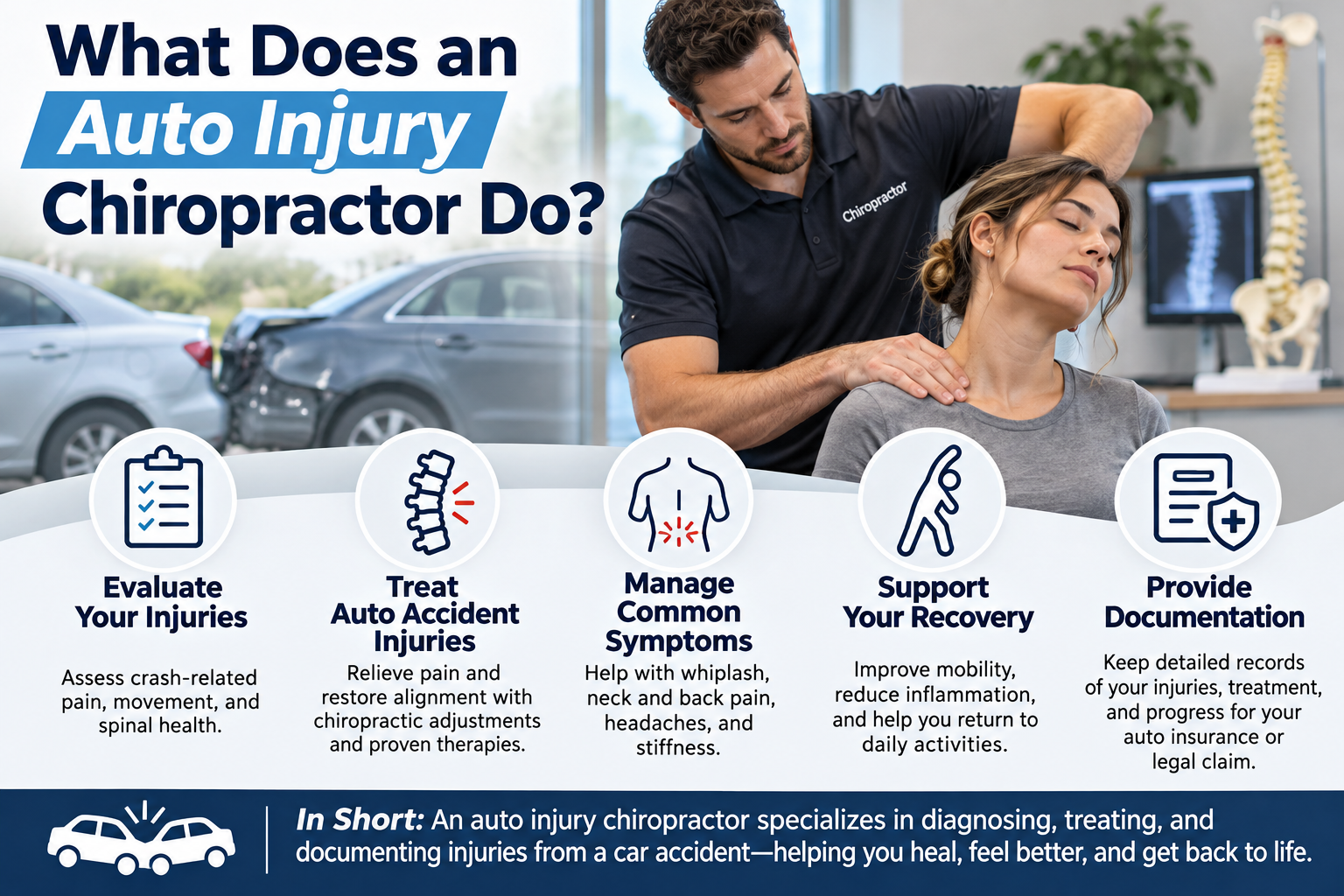
An auto injury chiropractor evaluates and manages appropriate non-emergency musculoskeletal problems after a motor-vehicle crash. The process may include reviewing the collision and medical history, screening for warning signs, examining movement and function, creating a conservative care plan, tracking progress, and coordinating records or referrals. Emergency symptoms and conditions outside chiropractic scope require emergency care or referral.
The first responsibility is appropriate triage
A chiropractor should not assume that every post-crash symptom is suitable for chiropractic care. Loss of consciousness, increasing confusion, worsening headache, repeated vomiting, severe bleeding, breathing difficulty, chest or abdominal pain, new weakness or numbness, suspected fracture, or severe spinal symptoms require urgent medical attention.
CDC guidance notes that concussion symptoms can appear immediately or hours or days later. Patients should report head contact, memory gaps, dizziness, vision changes, nausea, headache, unusual sleepiness, or changes in thinking and behavior.
Reviewing the accident and health history
A useful evaluation connects the patient’s symptoms to a factual timeline without guessing about fault or diagnosis. The provider may ask about:
- The direction and sequence of impacts
- Seat position, restraint use, and air-bag deployment
- Head contact, loss of consciousness, or memory gaps
- Immediate symptoms and symptoms that appeared later
- Emergency care, imaging, medications, and referrals
- Prior injuries, current conditions, and normal activity demands
Performing a musculoskeletal examination
Depending on the presentation, the examination may assess posture, tenderness, comfortable range of motion, strength, sensation, balance, coordination, and tolerance for activities such as sitting, walking, lifting, working, or driving. Findings help determine whether conservative care is reasonable or another provider should be involved.
Deciding whether imaging or referral is appropriate
An auto injury chiropractor does not need to order imaging for every patient. Imaging decisions should reflect the mechanism, symptoms, examination findings, prior studies, and recognized clinical criteria. Referral may be appropriate for emergency evaluation, primary care, orthopedics, neurology, pain management, behavioral health, or other services.
Creating a measurable care plan
When chiropractic and rehabilitation care is appropriate, the plan may use education, activity guidance, manual care, therapeutic exercise, mobility work, and progressive strengthening. The plan should explain the goals, expected reassessment points, alternatives, potential risks, home recommendations, and reasons the approach might change.
Progress should be measured with function as well as pain. Examples include improved sleep, safer head movement, longer sitting or walking tolerance, better ability to work, and gradual return to driving or exercise.
Coordinating clinical records
Auto injury care often involves more than one organization. With valid authorization, a clinic may exchange relevant records with medical providers, insurers, or attorneys. The chiropractor documents clinical history, findings, care, and progress. The clinic does not determine fault, interpret policy coverage, value a claim, or act as the patient’s lawyer.
Frequently asked questions
Is an auto injury chiropractor an emergency provider?
No. Emergency symptoms require 911, an emergency department, or another appropriate medical service. Chiropractic evaluation is for patients whose presentation is suitable for non-emergency musculoskeletal care.
Does every car accident patient need an adjustment?
No. Care should follow the individual evaluation. Some patients may need referral, exercise-based rehabilitation, education, monitoring, or another approach.
Can a chiropractor work with my physician or attorney?
With authorization, the clinic can coordinate clinical information. Medical and legal roles remain separate.
Sources
Centers for Disease Control and Prevention — Symptoms of Mild TBI and Concussion
MedlinePlus — Recognizing Medical Emergencies
T98 Rehab — Auto Accident Chiropractor
Choose a convenient T98 Rehab location
T98 Rehab provides non-emergency auto-injury evaluation and rehabilitation at three Central Texas clinics:
- North Austin — 1139 Braker Lane #101, Austin, TX
- South Austin — 2512 S. I-35 Frontage Road #260, Austin, TX
- Pflugerville — 201 N. Heatherwilde Boulevard #104, Pflugerville, TX
Call 512-614-2330 to request an appointment. If symptoms may represent an emergency, call 911 or go to an emergency department.
Medical and legal disclaimer
This article is for general education and is not a diagnosis, treatment plan, prognosis, insurance interpretation, or legal advice. Individual care requires evaluation by a qualified healthcare professional. T98 Rehab does not determine fault, value claims, decide coverage, provide legal representation, or guarantee medical or legal outcomes.